
A Floating Salon: Elite Passengers Aboard the SS City of Rome, 23 August 1884
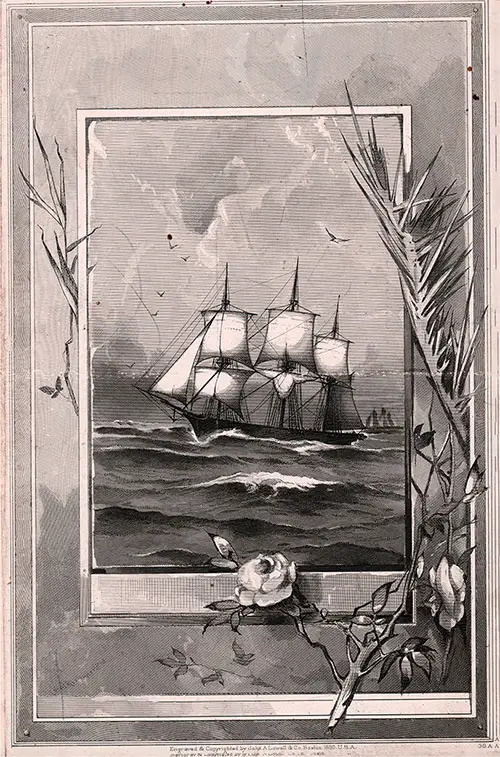
Front Cover for a Saloon Passenger List for the SS City of Rome of the Anchor Line, Departing 23 August 1884 from Liverpool to New York, Commanded by Captain R. D. Munro. The Front Cover Features an Engraved Sailing Vessel at Sea by John A. Lowell & Co., Boston (1880) – Classic Period Artwork That Makes This Much More Than a Simple Name List. It's A Decorative, Display-Worthy Artifact from The Golden Age of Steamship Travel. | GGA Image ID # 15b681d8d8
🌍 Voyage Overview
- Ship Name: SS City of Rome
- Operator: Anchor Line
- Captain: R. D. Munro
- Route: Liverpool → Queenstown → New York
- Departure Date: Saturday, 23 August 1884
- Class Covered: Saloon Class (First Class)
- Purpose: Luxury transatlantic voyage carrying elite travelers, religious figures, government officials, professionals, and affluent families
This journey occurred during the golden age of steamship travel, with the City of Rome representing the ambition and engineering prowess of its era.
Saloon passengers on this route typically included clergy, academics, business magnates, diplomats, and well-to-do families journeying between Britain, Europe, and North America for business, ministry, education, or extended travel.
This particular voyage carried an extraordinary cross-section of elite Victorian society:
- Religious leaders from multiple denominations
- Diplomats and consuls
- Judges and legal figures
- Professors, physicians, and professionals
- Affluent families traveling with children, nurses, and maids
For researchers, collectors, and institutions, this is a "floating salon" in print – a rare surviving record of who actually sailed on one of the most visually iconic steamers of the 1880s.
⚙️ Key Features of the SS City of Rome
- Launched: 1881 by Barrow Shipbuilding Company
- Length: 560 feet — among the longest ships of its day
- Tonnage: 8,415 gross tons
- Speed: Up to 17 knots
- Passenger Capacity: Over 1,000 (with approximately 300 in Saloon Class)
- Appearance: Famous three-funnel profile, richly appointed saloon accommodations, and ornate interiors
- Later Career & Fate: After service with the Anchor Line and other routes, she was eventually scrapped in 1900
The City of Rome was widely advertised as a showpiece of modern engineering and luxury. For many passengers, simply sailing on her was a status symbol.
Senior Officers and Staff
- Commander: Captain R. D. Munro
- Purser: B. Newsom
- Assistant Purser: J. W. Corbett
- Surgeon: Dr. Edmond Murphy
- Chief Steward: McConnell
- Stewardess: Mrs. Cook
- Stewardess: Miss Laurie
- Stewardess: Mrs. Rome
This listing offers a rare snapshot of shipboard hierarchy, listing not only the captain and surgeon, but also stewards and stewardesses who managed the daily comfort of Saloon passengers.
Saloon Passengers
- Mr. J. E. Aldons
- Mr. Edward Arnold (Note 1)
- Mrs. S. Ashley
- Mr. Noel Abbott
- Mrs. W. C. Andrews (Note 2)
- Lt. W. E. Ayer, U.S.A.
- Mr. M. F. Armington
- Rev. W. Angwin
- Mr. John Andrews
- Mr. J. C. Allan
- Mr. H. G. Anderson
- Mr. T. H. Armstrong (Note 3)
- Mrs. F. Baker
- Mr. J. Burn
- Mr. G. A. Bacon
- Mr. W. R. Bridgman
- Mrs. C. A. Bacon (Note 4)
- Miss Brittlebank
- Mr. Hugh Brittlebank
- Mr. George D. Bromley
- Miss Ellen Bromley
- Miss Ella Bromley
- Mrs. E. Blocksidge and Child
- Mrs. C. Blocksidge
- Mr. R. Barnes
- Mr. J. Brickwood (Note 5)
- Mr. B. Boorman (Note 6)
- Mrs. P. Britt (Note 7)
- Mr. M. M. Bowen
- Mrs. Bowen
- Miss Lilian Bowen
- Mr. H. Barron (Note 8)
- Mr. J. S. Bath
- Miss M. M. Bath
- Mr. O. G. Brooks
- Mrs. Brooks
- Mr. J. I. Blakslee (Note 9)
- Mrs. Blakslee
- Mr. C. A. Blakslee (Note 10)
- Mr. T. E. Brewster
- Mr. W. A. Briscoe
- Mrs. Briscoe
- Mr. G. W. Balch
- Mrs. Balch
- Miss Bessie Balch
- Miss Kate Balch
- Master Fred Balch
- Mrs. G. H. Barrett
- Miss L. A. Barron
- Mr. W. Bradford (Note 11)
- Mr. B. Bowron
- Rev. G. Beckett
- Mr. A. C. F. Boulton (Note 12)
- Mr. Guido Bossard
- Miss L. Barth
- Miss H. A. Biddle (Note 13)
- Rev. P. Brophy
- Rev. Ed. Cockburn
- Mrs. Cockburn
- Mr. G. C. Crane
- Mrs. C. Cook
- Miss Carrie Cook (Note 14)
- Mr. Fred. M. Crunden (Note 15)
- Mr. A. Cochrane
- Mrs. Cochrane
- Mr. S. T. Culp (Note 16)
- Mrs. Culp (Miss Annie McArthur)
- Mr. A. Coleby
- Mr. G. L. Curtis
- Mr. James Cumming
- Miss Crawford
- Mr. J. H. Coit
- Mr. A. T. Clarke
- Miss Lou Clark
- Mrs. E. K. Clark
- Master A. F. Clark
- Mr. A. G. Cameron
- Miss S. Cheek
- Mr. H. M. Chester (Note 17)
- Mr. Jos. Culbert
- Miss Gertrude Culbert
- Mr. Wm. Crawford
- Mr. John Crawford (Note 18)
- Mr. D. Crawford
- Mr. W. J. Campbell
- Miss Cooper
- Rev. J. Cuckson (Note 19)
- Mrs. Cuckson
- Mr. A. Clarke
- Mr. W. V. Davis
- Mr. J. Doran
- Mrs. Doran
- Mr. A. Douglas
- Mr. D. W. Dickson
- Miss E. P. Dye
- Mr. Y. Druon
- Mr. P. N. Degerberg
- Miss E. Dodson
- Mrs. Mary C. Davidson (Note 20)
- Miss E. Down
- Mr. John Dawson
- Dr. Frank Donaldson (Note 21)
- Miss M. Dougall
- Miss L. Dougall
- Mr. James G. De Witt
- Rev. W. J. Darby
- Mr. P. R. Danby
- Mr. E. B. Dorsey
- Mr. L. E. Dyer
- Mr. Peter Eadie
- Mr. E. T. Ekey
- Mr. H. L. Edwards
- Mrs. J. B. Fisher
- Miss J. G. Fisher
- Mr. G. W. Fetter
- Miss A. E. Freeman
- Mr. Charles Forrest
- Miss Francis Fisher (Note 22)
- Miss H. H. Forsayeth
- Mr. J. M. Fitzgerald
- Mr. Thomas Farr
- Mr. L. T. R. Franca
- Mrs. Franca
- Miss Victoria Franca
- Miss Beatrez Franca
- Mr. F. T. Gates (Note 23)
- Mr. J. P. Green (Note 24)
- Mrs. Green
- Miss P. Green
- Miss Marie Green and Maid
- Master K. S. Green
- Mr. John Goldie (Note 25)
- Mrs. Goldie (Note 26)
- Miss Nellie Gunn
- Mr. W. T. Galey
- Mr. F. Gardner
- Miss Galey
- Mr. A. H. Greenawalt
- Mrs. Greenwalt
- Mr. Edward Gray
- Mrs. Gray
- Mr. John Gibson
- Mr. Guinness
- Mrs. Guinness
- Mr. M. Hagerty
- Mrs. Hagerty
- Miss Mary Hagerty
- Miss Kate Hagerty
- Mr. J. B. Hagerty
- Mr. G. Hoyt
- Mr. Chas. H. Hayes
- Mrs. Hayes
- Mr. J. Hay
- Miss J. L Hay
- Mr. J. E. Howard
- Don Manuel Herrerias
- Don Herrerias
- Mrs. E. M. Hattersley
- Mrs. Hughes
- Mrs. Dr. A. F. Hawkins and Child
- Miss May Hawkins
- Mr. John J. Hardy
- Mr. J. W. Haine
- Mr. T. Hughes
- Mrs. M. C. Hinman
- Mr. A. G. Howard
- Mrs. E. H. Habick
- Mr. F. G. Harvey
- Mrs. Hartley
- Mr. W. S. Hurry
- Mrs. D. Hynes
- Mr. J. H. Hudson
- Mr. W. B. Hislop
- Mrs. Hislop
- Mrs. W. H. Hornblower
- Mr. J. C. Hornblower
- Miss J. Izaguirre
- Mrs. C. Ingham and Child
- Mr. J. H. Irvine
- Mrs. R. Johnson
- Miss Mary Johnson
- Mr. R. James
- Mr. H. S. Johnson
- Mr. S. B. Joseph
- Miss R. P. Jacobs
- Mrs. R. L. Jones and Infant
- Miss Emma Jones
- Miss E. Jackson
- Mrs. Kimber
- Miss J. Kimber
- Mr. George Knowles
- Mrs. Knowles
- Mr. Walter H. Kent
- Miss Kenway
- Mr. P. Kenway
- Mr. H. C. Kroh
- Mrs. Kroh
- Mr. Peirse Kelly
- Mrs. W. T. Kitsell
- Mr. H. Kimber
- Mr. E. W. Kennedy
- Mr. Melville D. Landon (Note 27)
- Mrs. Landon
- Mr. Frank Land
- Mr. Ed. Lees
- Rev. W. Lloyd
- Mr. David Lyell, Sr.
- Mr. David Lyell, Jr.
- Mrs. J. R. Laing
- Master W. J. Laing
- Miss Geneva Laing
- Mr. C. A. Liffiton
- Mr. C. Lecaille
- Rev. James Morton
- Mrs. Morton
- Mr. W. W. Montgomery
- Mr. Robt. Martin (Note 28)
- Dr. George Macloskie (Note 29)
- Mrs. Macloskie
- Mr. Chas. Macloskie
- Master G. Macloskie
- Mr. Wm. McGregor
- Mrs. McGregor
- Miss Anna McGregor
- Miss Maggie McGregor
- Miss Jessie McGregor
- Prof. Montgomery
- Mr. W. McCallum
- Mrs. McCallum and Child
- Mr. J. C. Mink
- Mrs. Mink
- Mr. W. J. Matthews
- Miss Maggie Mitchell (Note 30)
- Mr. P. McCallum
- Miss M. McCallum
- Dr. A. H. McHatton
- Mr. Thomas H. Miller
- Mrs. Miller
- Mr. E. B. I. Müller
- Rev. C. D. Morris
- Mr. George Morgan
- Mrs. Morgan
- Mr. D. MacNiel
- Mrs. MacNiel
- Miss Bessie MacNiel
- Miss Carrie McNiel and Maid
- Mr. W. E. Mead
- Mr. J. E. Morris
- Mr. Craig A. Marsh
- Mrs. Marsh
- Mr. James Moore
- Judge F. A. Macomber (Note 31)
- Mrs. E. Maynard
- Mr. M. Maynard
- Mrs. Maynard
- Mr. R. F. Maynard
- Mr. James B. Murphy, Q.C. (Note 32)
- Mr. James Murphy
- Miss Marion Milne
- Mr. A. W. Mudge
- Mrs. Mudge
- Mr. E. F. Moloughney
- Mr. E. J. Moloughney
- Mrs. M. A. Moloughney
- Mrs. McIntosh
- Mr. A. J. Mitchell
- Mr. W. E. H. Massey
- Miss Massey
- Mr. R. J. Marden
- Mr. J. S. Morse
- Dr. M. Meigs (Note 33)
- Rev W. McDonald (Note 34)
- Mr. George M. Nichols
- Mr. W. D. Noyes
- Mr. C. P. Negroponte
- Mr. G. H. Norris (Note 35)
- Mrs. Norris
- Mr. J. Newman
- Mr. James Nichols
- Mr. Wm. Nicholson
- Mr. G. A. Ovens
- Miss M. Ormerod
- Mr. Thos. Ogg
- Mr. T. H. O'Neill
- Mr. J. B. O'Brien
- Mr. E. L. Oppenheim, U.S. Consul at Cadiz (Note 36)
- Mr. N. Paulson
- Mrs. Paulson
- Mrs. Parnell
- Mr. Pollock
- Mr. G. F. Phillips
- Miss M. A. Platt
- Mr. J. Patterson
- Mrs. Patterson
- Miss E. J. Patterson
- Mr. J. Priddis
- Mrs. Priddis
- Miss Bessie Patterson
- Mr. Henry Parfitt
- Mrs. Parfitt
- Master A. Parfitt
- Miss E. Parsons
- Mr. C. Parsons
- Mr. Pesant
- Miss Parsons
- Miss Edith Pethick
- Mr. J. Pike
- Dr. J. Partridge
- Mr. R. Parker
- Mr. Louis D. Paldi
- Mr. J. J. Palmer
- Dr. T. M. Prudden (Note 37)
- Mr. Alex. C. Robinson
- Mr. Edward Rorke
- Mr. Edward A. Rorke (Note 38)
- Miss Mary Rorke (Note 39)
- Mr. F. Renaud (Note 40)
- Mrs. Renaud
- Honorable R. G. Richards (Note 41)
- Senor Juan Rodriquez
- Mr. James Ridgway
- Mrs. Ridgway
- Lt. T. Ridgway (Note 42)
- Miss E. M. Ridgway
- Mr. Hugo Rosenberg
- Mr. B. O. Rodes
- Rev. E. H. Rutherford
- Mrs. Rutherford
- Mrs. J. W. Ricker (Note 43)
- Mr. G. H. Rout
- Mrs. Rout
- Miss C. Rout
- Rev. B. E. Reed
- Mr. Wm. Reid
- Mr. C. P. Robinson
- Mr. Frank Smyth
- Miss M. Stovel
- Mr. W. Stebbins
- Mr. F. W. Stephenson
- Mrs. Stephenson
- Mr. L. Sinsheimer
- Mrs. Sinsheimer
- Miss Hanna Sinsheimer
- Master H. Sinsheimer
- Master Benny Sinsheimer
- Master Alex. Sinsheimer
- Miss Sword
- Mr. H. E. Stockbridge
- Mr. R. Smith
- Senr. Mr. R. Smith, Jr.
- Mr. G. S. Smith
- Mrs. Smith
- Mr. Robert Smith
- Mr. Samuel R. Stott
- Mr. James Shea
- Mr. Thomas Shedd
- Senor D. Marco A. Soto (Note 44)
- Mr. C. F. Stewart
- Miss Louisa Scott
- Mr. H. Savile
- Mr. James Seeley
- Mr. W. E. Swentzel
- Mrs. Swentzel and Child
- Mr. F. A. Sayles
- Mr. E. J. Sanders
- Mrs. Sanders
- Mr. Alder Smart
- Mr. H. J. Schlaepfer
- Mr. T. J. Simmons (Note 45)
- Miss Symington
- Miss R. Sims
- Mrs. J. T. Smith
- Mr. Wm. T. Schaefer
- Mr. W. Sanderson
- Mr. J. C. Scott
- Mrs. Scott
- Mr. W. Smith
- Marquis De Piro Testaferrata (Note 46)
- Mrs. Thompson
- Mr. Walter Thompson
- Rev. J. G. Taylor
- Mr. E. Tapscott
- Mr. Julius Townsend
- Mr. Joseph Thompson
- Mrs. Thompson and Maid
- Mrs. Leah Thompson
- Miss Mattie Thompson
- Master John Thompson
- Mr. Thos. E. Turner
- Mr. Turner
- Mrs. Turner
- Mr. V. G. Thomas
- Mr. F. G. Thomas
- Mrs. Tait
- Mr. Parfitt Thomas
- Mrs. J. Traverse
- Mr. R. S. Van Cleve
- Mr. H. B. Western
- Mrs. Western and Child
- Miss S. Winslow
- Mr. P. H. Wickland (Note 47)
- Rev. G. K. Ward
- Mr. W. E. Whyte
- Miss Florence Woodward
- Mr. A. M. Wilcox
- Mr. A. White
- Mrs. White
- Mr. A. White
- Mr. G. G. Ward
- Mrs. Ward
- Mr. J. J. Wilder, Russian Consul. Savannah (Note 48)
- Mr. W. W. Williamson
- Mrs. E. Worthington and Child
- Miss Ella Warren
- Mr. Thos. Wilbraham
- Mrs. Wilbraham
- Mr. Thos. Whitridge (Note 49)
- Miss A. Waller
- Miss V. Waller
- Mr. R. T. Wright
- Mrs. Wright
- Mr. J. A. Walsh
- Miss A. B. Weir (Note 50)
- Mr. Williams
- Mr. Charltin Yornall (Note 51)
- Mr. E. B. Watson
- Mr. W. C. Young
- Mrs. Young
- Mrs. C. C. Young
- Miss E. Young
- Miss S. Young
Notes About Saloon Passengers
- In the late 1800s, the prominent figure was Sir Edwin Arnold (1832-1904), a British poet and journalist famous for The Light of Asia (1879), an epic about Buddha, and his work with The Daily Telegraph. Key Works: The Light of Asia (1879) about Buddha; Pearls of the Faith (1883) on Islam; The Light of the World (1891) on Christ; Japonica (1892) and Adzuma (1893) on Japan. Career: Journalist for The Daily Telegraph, serving as editor-in-chief (1873-1889). Influence: Introduced Eastern philosophies to Western audiences, sparking interest in Japan and Buddhism.
- "Mrs. W. C. Andrews" in the late 1800s likely refers to Willie Ann Hudson Andrews (1848-1895), a pioneering Texas educator who founded innovative coeducational schools in South Central Texas. Established schools in Gonzales, Caldwell, and Hays Counties, Texas, promoting coeducation. Active in the late 1800s, founding schools like the Science Hall Institute and Austin Home Institute. Her efforts were significant in Texas education history.
- "Mr. T. H. Armstrong" in the late 1800s could refer to Thomas Henry Armstrong (1829-1891), a prominent Minnesota politician and Lieutenant Governor involved in law, banking, and legislature. A lawyer, banker, and legislator who served as Minnesota's Lieutenant Governor (1866-1870) and was active in state politics in the latter half of the 19th century before his 1891 death.
- Mrs. C. A. Bacon most likely refers to Clara Latimer Bacon (1866-1948), a prominent American mathematician and professor. Education Born in Knox, Illinois, graduated from Hedding College in 1886 and received a second bachelor's degree from Wellesley College in 1890. She later earned her Master's degree from the University of Chicago and became the first woman to receive a PhD in mathematics from Johns Hopkins University. Career She was a long-serving mathematics professor at Goucher College (formerly the Woman's College of Baltimore). Timeframe Her activities during the late 1800s included her college education and the beginning of her teaching career in the years between 1890 and her master's studies in the early 1900s.
- "Mr. J. Brickwood" in the late 1800s likely refers to Sir John Brickwood (1852-1932), a prominent English brewer from the influential Brickwood & Co. brewery in Portsmouth, who expanded significantly in the late 19th century. A key figure, often linked to the National Portrait Gallery as a sitter, representing the growth of the brewery. Brickwood & Co.: Founded by Fanny Brickwood in 1851, grandsons John and Arthur took over around 1875, moving to larger premises and registering as a limited company in 1891, making the late 1800s a period of major expansion. Portsmouth Breweries: They acquired several breweries, including the Cobden Arms, Hyde Park, Tessier & Co., and Jewell's Catherine Brewery, becoming the largest brewer and pub owner in the area by the turn of the century.
- "Mr. B. Boorman" in the late 1800s likely refers to Benjamin Boorman (1830-1886), a significant American businessman involved in railways (Hudson River Railroad), banking (Bank of Commerce), and trade (tobacco, Swedish/Russian iron). Family: Married to Elizabeth A. Gregg (d. 1874); children included William Gregg Boorman (1860-1921) and Winifred B. Boorman (1873-1951). Business: Active in New York commerce, linked to significant trade and financial institutions.
- "Mrs. P. Britt" in the late 1800s most likely refers to Mrs. Peter Britt (Amalia Grob Britt), wife of Oregon photographer Peter Britt, who was active in Jacksonville, Oregon, with her husband and son in the photography business (P. Britt & Son) during that era, as suggested by historical photo collections from the region. Who: Amalia Grob, who married photographer Peter Britt. When: Active with her husband's photography business, P. Britt & Son, in the late 19th century. Where: Jacksonville, Oregon, a noted historical area. Why: Historical archives feature photographs of her and mention her role with Peter Britt's studio.
- Mr. H. Barron" most likely refers to Henry D. Barron (1833–1882), an American lawyer, politician, and judge in Wisconsin, who was active in the late 1800s and for whom Barron County, Wisconsin was named. A prominent figure in Wisconsin history, he served as the Speaker of the Wisconsin State Assembly and a circuit court judge. He held various public offices and was a member of the University of Wisconsin Board of Regents. Barron County, Wisconsin, was named in his honor in 1869.
- James I. Blakslee (1805-1901) In 1833 he removed with his brother-in-law, Asa Packer, to Mauch Chunk, and devoted the first two years to the occupation of a boatman on the Lehigh Canal. The four years following were spent as clerk in a country store, after which, in 1839, he engaged in the mining and shipping of coal in Schuylkill County. Returning to Mauch Chunk in 1844, from that date until the beginning of the construction of the Lehigh Valley Railroad, in 1851, Mr. Blakslee was engaged in the preparation and shipping of coal from the Nesquehoning mines, worked by Messrs. Mapes, Packer and Harlan, under contract with the Lehigh Coal and Navigation Company. He also superintended the building of what is known as "Stone Row," in Mauch Chunk, and "Packer's Corner," a building occupied by Judge Packer before the erection of the mansion where he subsequently resided, and where his death occurred. Mr. Blakslee assisted in the construction of the Lehigh Valley Railroad and was conductor of the first coal-train that ran over the road, subsequently acting as conductor for eight years of a passenger train on the same road. In the spring of 1863, he was made superintendent of the Mahanoy Division of the Lehigh Valley Railroad, which position he still holds. In 1871 he was elected and still officiates as president of the Montrose Railroad, extending from Tunkhannock, Wyoming Co., to Montrose, Susquehanna Co., the construction of which he personally superintended. He was in 1878 elected a director of the Lehigh Valley Railroad and has been for years a member of the executive committee of its board of directors.
- Mr. C. A. Blakeslee" in the late 1800s likely refers to Charles Albert Blakeslee, a prominent New Haven contractor and businessman involved in street paving and railways. Born 1824, he was active in New Haven, Connecticut, starting in the 1840s, and built a substantial business in street paving and railway construction by the 1870s and 1880s, making him a notable "Mr. Blakeslee" of that era.
- "Mr. W. Bradford" in the late 1800s most likely refers to William Bradford (1823-1892), an American romantic painter and explorer known for his Arctic scenes, ship portraits, and early photography, particularly from New Bedford, Massachusetts, creating art during that era. Other notable Bradfords existed, like historical figures from earlier times or farmers, but William the artist fits the timeframe of significant artistic activity in the late 19th century. Career: He was a prominent painter, photographer, and explorer. Subject Matter: Famous for his depictions of the Arctic, ships, and maritime life, often based on his own expeditions. Time Period: Active and creating significant works, including paintings like Arctic Scene – Fishing Boats at Sunset Labrador, during the latter half of the 1800s. Origin: Hailed from Fairhaven, Massachusetts, a whaling hub.
- Mr. A. C. F. Boulton likely refers to Alexander Claude Forster Boulton (1862–1949), a British barrister and politician active in the late 19th/early 20th century, known for co-founding the precursor to the English-Speaking Union, though the name "A.C.F. Boulton" could also be confused with historical figures like Matthew Boulton (Industrial Revolution) or D'Arcy Boulton (Canadian colonial official). The initials align with Alexander C. F. Boulton, a prominent figure in the liberal party and legal writing. Key Achievement: Co-founded the Atlantic Union, which later became the English-Speaking Union. Publications: Author of legal textbooks.
- The Biddle family was a wealthy and prominent clan in Philadelphia's early years. They were involved with the city's financial, legal, and mercantile affairs and were also patriots with extensive military careers.
- Carrie Cook (née Knowles; 1876–1986) She would later become a verified American supercentenarian. She was born as Carrie Dyer Knowles in Provincetown, Massachusetts on 5 February 1876 as the daughter of George and Georgia Dyer Knowles. Her mother lived to be 102. Her father was the owner of a whaling fleet in Provincetown, called the Knowles Wharf. One of the boats was named after Carrie. The whaler Carrie D. Knowles also became famous due to it having disappeared with crew and everything during a whaling trip in 1904. Knowles married her husband Irving Cook in Provincetown, Massachusetts on 14 June 1899. The couple would have four children.
- Frederick Morgan Crunden (1847–1911) was the head librarian of the St. Louis Public Library in St. Louis, Missouri, from 1877 to 1909 and the president of the American Library Association in 1887-1889. Crunden was born in Gravesend, England to Benjamin and Mary (Morgan) Crunden. The family immigrated to the United States and settled in St. Louis, Missouri, when Crunden was still a child. He attended Washington University in St. Louis, graduating in 1868 with a Bachelor of Arts. Crunden taught in St. Louis public schools and at Washington University in St. Louis where he received a master's degree in 1872. In January 1877 he became secretary and librarian of the St. Louis Public Library which was, at the time, part of the St. Louis Public Schools. In 1904, Crunden hosted the American Library Association annual meeting at the Louisiana Purchase Exposition in St. Louis, which was attended by more than 500 librarians from 17 countries.
- Samuel Thaddeus Culp (1851-1929), also known as S. T., Culp, built a brick complex of stores in downtown Littleton in 1891-1892. Known as the Culp block, it stretched from Prince Street along the south side of Main almost to mid-block. He had bought the property from F. W. Ostrander and declared his intention of building five storefronts. One of the first occupants was O. M. Hurst, who, the newspaper announced, would be starting a furniture, crockery, carpet and undertaking establishment May 1, 1892. In March 1893 Bob Nelson took advantage of the current popularity of bicycling to rent a room formerly occupied by a restaurant in the Culp block and put in a stock of bicycles and bicycle supplies. By April 1895 Nelson's advertisement in the Littleton Independent described his shop as "The Wheelmen's Headquarters." He also carried tobacco, confectionery, sportsman's goods and soft drinks of all kinds. Samuel Culp made and sold his jewelry, traveling widely. S. T. was an inventor of note and held several patents. In the forty years S. T. Culp lived in Littleton, he was active in business and civic affairs. It is said that he eventually owned thirteen stores on Main Street.
- "Mr. H. M. Chester" most likely refers to Henry Marjoribanks Chester (1832–1914), a British civil servant and magistrate in Queensland, Australia, known for his role in the annexation of a portion of New Guinea in 1883. During the late 1800s, H. M. Chester held several significant positions and was involved in notable events: Annexation of New Guinea: On April 4, 1883, acting on orders from the Queensland government, he formally claimed the unoccupied eastern half of New Guinea for the British Empire by raising the Union Jack at Port Moresby. This act was initially disavowed by the British government but spurred later official annexation. Police Magistrate and Public Servant: He had a long career in Queensland public service, beginning in 1866. During the late 1800s, he served as a police magistrate in several remote and frontier locations, including Somerset (on the northern tip of Cape York Peninsula), Thursday Island, the Croydon goldfield, Cooktown, and Clermont. Controversies: He was known for being a strict and unpopular official in some postings, particularly at Cairns and Clermont, where he clashed with local officials and was at times "lampooned by a local editor". Naval and Military Service: An old naval officer who had served in the British East India Company's Naval Service (the "Indian Navy"), he later served as a lieutenant in a Queensland Volunteer Defense Corps in the mid-1880s, giving him the distinction of serving as an officer in both the navy and the army.
- Possibly John Wallace ("Captain Jack") Crawford (1847–1917), known as "The Poet Scout", was an American adventurer, educator, and author. "Captain Jack" was a master storyteller about the Wild West and is known in American history as one of the most popular performers in the late nineteenth century. His daring ride of 350 miles in six days to carry dispatches to Fort Laramie for the New York Herald, to tell the news of the great victory by Gen. George Crook against the village of Chief American Horse at the Battle of Slim Buttes during the Great Sioux War of 1876-1877, made him a national celebrity.
- Reverend J. Cuckson (John Cuckson) was a prominent figure, notably as the author of a historical account of the First Church in Plymouth, Massachusetts, published in the early 1900s, but likely based on work and research done in the late 1800s. Published Work: He authored A Brief History Of The First Church In Plymouth: From 1606-1901, which was published in 1902. This work indicates his active involvement in historical and religious scholarship around the turn of the century. Other Works: He also produced other materials related to the church, such as Services of Christian worship in the First Church (1911). Time Period: His work and publications place him as active in the late 1800s and early 1900s.
- Mary C. Davidson (1865–1951) was a Scottish artist, notable for her landscape and flower paintings. She painted landscapes in both Scotland and France. In 1936 Davidson visited India where, among other landscapes, she produced a series of paintings of the mosque at Kohat, now in modern-day Pakistan. Davidson lived in Edinburgh for many years but gave up her art career for an extended period to care for her parents and only resumed painting after their deaths, but failing eyesight cut short her own career. Davidson had twenty-four paintings exhibited at the Royal Scottish Academy between 1906 and 1936. In 1936 she was elected a member of the Royal Watercolour Society, who showed some 44 of her works during her career. She was also a regular exhibitor with both the Aberdeen Artists Society and the Royal Glasgow Institute of the Fine Arts.
- Frank Edward Donaldson (1876-1939) Until the age of about 25 he used the name 'Edward' rather than 'Frank.' He was a medical doctor and graduated in 1899 from National Medical University (Chicago, IL). For secondary school he took the Latin Scientific Course, in Waupaca, Wisconsin. After his training he had a medical practice for six years in Butte, Montana, where he married Rosalind Main (1878-1961) on 19 Apr 1899.
- Frances Fisher Wood (1852-1938), sometimes styled Mrs. William Benjamin Wood was an educator, lecturer, and scientist. A graduate of Vassar College, Frances Fisher Wood supported women's suffrage and education. On August 10, 1886, in Cleveland, Ohio, Frances Fisher married Dr. William Benjamin Wood (1851-1929). She was a teacher and principal at what later became the Hathaway Brown School for Girls in Cleveland, Ohio; lectured and published a book on the scientific upbringing of infants and children (Infancy and Childhood, 1897); developed the first commercial business in the United States for the sterilization of milk for infants; and was a founder and one of the original trustees of Barnard College for women. While a student at Vassar, Frances Fisher was an enthusiastic proponent of "rational dress", petitioning for the right to wear "mountain dress, consisting of a short, kilted skirt and a comfortable jacket." She successfully led a "Petticoat war", popularizing the shortening of skirts and the removal of heavy petticoats. She was variously described as a "Japanese scholar and expert" and an "Oriental art expert and dealer". Items that she owned were later given to the Memorial Art Gallery at the University of Rochester. Frances Fisher Wood was one of the founders of the Public Education Society in New York, established in 1888. She served as a vice-president of the organization, which was intended for the investigation and reform of the public school system. During World War I Frances Fisher Wood worked as a volunteer, writing publicity articles for Camp Sherman, Ohio. Her son Eric Fisher Wood was an officer there in 1917.
- Likely Frederick Taylor Gates (1853–1929) was an American Baptist clergyman, educator, and the principal business and philanthropic advisor to the major oil industrialist John D. Rockefeller, Sr., from 1891 to 1923. On January 21, 1889, Gates met the lifetime Baptist, John D. Rockefeller, Sr. He proved to be central to the suggestion and subsequent design of the funding plans for the creation by Rockefeller, Sr. of the Baptist University of Chicago; he subsequently served for many years as a trustee on its board. Gates then became Rockefeller's key philanthropic and business adviser, working in the newly established family office in Standard Oil headquarters at 26 Broadway, where he oversaw Rockefeller's investments in many companies but not in his personal stock in the Standard Oil Trust. From 1892 onwards, faced with his ever-expanding investments and real estate holdings, Rockefeller Sr. recognized the need for professional advice and so he formed a four-member committee, later including his son, John D. Rockefeller Jr., to manage his money, and nominated Gates as its head and as his senior business adviser. In this capacity Gates steered Rockefeller Sr. money predominantly to syndicates arranged by the investment house of Kuhn, Loeb & Co., and, to a lesser extent, the house of J. P. Morgan. Gates served on the boards of many companies in which Rockefeller had a majority shareholding; the latter then held a securities portfolio of unprecedented size for a private individual. Although Gates is recognized today as a philanthropic advisor, Rockefeller himself regarded him as the greatest businessman he had encountered in his life, skipping such prominent figures of the time as Henry Ford and Andrew Carnegie. When he ceased being a business advisor to Rockefeller in 1912, Gates continued to advise him and his son, John D. Rockefeller Jr., on philanthropic matters, at the same time serving on many corporate boards. He also served as president of the General Education Board, which was subsequently merged into other Rockefeller family institutions.
- John Patterson Green (J.P. Green) 1845–1917 was a prominent African American lawyer, politician, and Civil Rights activist from Cleveland, Ohio. He was active in Republican politics, served in the Ohio legislature, and was known for his legal work and advocacy.
- John Goldie (1793 –1886) was a Scottish-born botanist, author, and miller. He is credited with recording the existence of fourteen plant species previously unknown to science including Dryopteris goldieana, Stellaria longipes and Drosera linearis.
- Mrs. John Goldie - Margaret Smith, daughter of James Smith, a well-known Glasgow botanist and florist.
- Melville De Lancey Landon (1839–1910), also known by his pen name Eli Perkins, was an American humorist, lecturer, and journalist. He attended Madison University (now Colgate University) for one year and graduated from Union College in 1861. After graduation, he obtained a position in the United States Treasury and served in the Civil War under General Augustus Louis Chetlain. He left the army in 1864 and became a cotton planter in Louisiana and Arkansas. In 1867 he traveled abroad in Russia as secretary to Cassius M. Clay, Minister to Russia. He returned to the United States in 1870, and the following year published his first book, The Franco-Prussian War in a Nutshell. He wrote and compiled several books of humor and was past president of the New York News Association.
- Likely Robert Martin (1833–1897), a Republican lawyer and native of Pennsylvania who moved to Oklahoma Territory in 1889 and served as Secretary (1890–1893) and acting governor of Oklahoma Territory (1891 to 1892).
- George Macloskie (1834-1920) was an Irish naturalist. He studied natural science and physics at Queen's University Belfast until 1958. He then studied theology and from 1861 to 1873 was a Presbyterian parish priest in Ballymoney. From 1875 to 1906 he was professor of biology at Princeton University. He was awarded honorary doctorates from Queen's University and the University of London. He was a member of several scientific societies and wrote books and articles on insects and botany, among other things.
- Miss Maggie Mitchell (1832-1918) was a beloved American stage actress famous in the late 1800s for her vivacious, childlike roles, especially Fanchon, the Cricket, captivating audiences and even President Lincoln with her charm, retiring in 1892 after a decades-long career playing gamine characters in popular dramas, solidifying her status as a theatrical icon before the rise of silent film stars. Signature Roles: She became iconic as the spirited country girl in Fanchon, the Cricket, and also starred in Little Barefoot, Jane Eyre, and The Pearl of Savoy. "Maggie Mitchell Craze": Her energetic, petite, and relatable portrayals sparked immense popularity, with fans loving her "artless laugh" and youthful energy. Presidential Admiration: Her performances were seen by President Abraham Lincoln, Ralph Waldo Emerson, and Henry Wadsworth Longfellow, who praised her. Theatrical Rivalry: She shared the spotlight with another popular "girl" actress, Lotta Crabtree, with both playing popular roles like Fanchon and Mignon. Retirement & Legacy: Mitchell retired from the stage around 1892, leaving behind a significant legacy as a beloved figure in 19th-century American theater.
- Judge Francis Allen Macomber (1837 - 1893) attended Oakfield Seminary, Middlebury Academy and graduated from the University of Rochester in 1859. He was a law student in Rochester from 1859-1861, practiced law in the city from 1861-1879, and then served as a judge on the New York State Supreme Court, 7th Judicial District, from 1879 until his death in 1893. He served as a trustee of the University of Rochester from 1871-1893.
- James Murphy (1823–1901) was an Irish barrister and judge of the late nineteenth century. He was born at Kilfinane, County Limerick, the fifth son of Jeremiah Murphy. He matriculated at Trinity College Dublin in 1842 and took his bachelor's degree there in 1849. He entered Lincoln's Inn in 1847 and was called to the Bar in 1849. He became Queen's Counsel (Q.C.) in 1866. He was a superb advocate, noted for his "persistence, pathos and humor" in argument. He made his reputation as counsel for the prosecution in the Phoenix Park murders trials in 1883, and later that year was duly rewarded for the successful outcome of the trials (from the Crown's point of view) by appointment to the High Court. He sat first in the Common Pleas Division before being transferred to the King's Bench Division. He then transferred to the Exchequer Division, before finally returning to the King's Bench. He was appointed to the Privy Council of Ireland in 1890. As a judge he was noted for dignity and efficiency rather than for profound legal learning. His judgments were generally considered to be right, and were rarely overturned on appeal, but very few of them were deemed worth reporting for their legal principles.
- Dr. William Montgomery Meigs (1852-1929), lawyer, author and member of a prominent Philadelphia family, the son of Dr. John Forsythe and Mrs. Ann Wilcock Meigs, graduated from the University of Pennsylvania in 1872, later receiving his master's degree and a medical degree. He forsook medicine for the legal profession and was admitted to the bar in 1879. Dr. Meigs wrote several books, some of which are related to the practice and theory of law. They include "Life of Josiah Meigs," "Life of Charles Jared Ingersoll," "Growth of the Constitution," "Life of Thomas Hart Benton," "Life of John C. Calhoun" and "Relation of the Judiciary to the Constitution." Dr. Meigs was unmarried and lived with his sister, Miss Ann Ingersoll Meigs in New York.
- "Rev. W. McDonald" in the late 1800s likely refers to Rev. William McDonald (1820-1901), a prominent Methodist minister, hymn writer (Beulah Songs, Tribute of Praise), and evangelist known for his role in compiling gospel songbooks and his later evangelistic circuit across the U.S. Known For: Methodism, hymnology (compiler of popular gospel songbooks like Beulah Songs), and extensive revival meetings.
- Possibly Sir Henry George Norris (1865 –1934) was an English businessman, politician and football club director, most famous for his chairmanship of both Fulham and Arsenal. Norris left school at 14 to join a solicitor's firm, leaving 18 years later to pursue a career in property development trade, partnering W.G. Allen in the firm Allen & Norris. He made his fortune building houses in south and west London — Fulham in particular. He was commissioned into the 2nd Tower Hamlets Rifle Volunteers in 1896 but resigned the following year. He was later Mayor of the Metropolitan Borough of Fulham from 1909 to 1919, a member of the London County Council from 1916 to 1919 and served as Conservative Member of Parliament (MP) for Fulham East from 1918 to 1922, retiring after falling out with his party on the issue of tariff reform. During World War I Norris had worked heavily as a military recruitment officer for the British Army. He served in the 3rd Middlesex Artillery Volunteers and in the 1917 Birthday Honors he was knighted and given the honorary rank of colonel for services to his country.
- Mr. E. L. Oppenheim was Ernest L. Oppenheim, the United States Consul in Cadiz, Spain, during the late 1800s (circa 1877-1905), known for his diplomatic correspondence, particularly regarding the Panama Railroad Company and family matters, with records held at the New York Public Library. He was a contemporary of, but distinct from, the more famous German archaeologist and diplomat Baron Max von Oppenheim, who was involved with German consulates and antiquities, but not primarily as the U.S. Consul in Cadiz.
- Dr. T. Mitchell Prudden (1849-1924) was a pivotal American pathologist and bacteriologist in the late 1800s, pioneering bacteriology in the U.S. by bringing new techniques from Europe (like Robert Koch's methods), establishing the first bacteriology course in NYC, and co-founding the Pathology Department at Columbia University. He was instrumental in public health, working with the NYC Board of Health on diphtheria and cholera screening, and was a significant figure at the Rockefeller Institute, also known for his interest in paleontology and archaeology. Pathology Pioneer: Considered a founder of pathology as a research field in the U.S. Bacteriology Leader: Introduced modern bacteriological methods to American medicine, studying under Koch in Germany. Bacteriology Leader: Introduced modern bacteriological methods to American medicine, studying under Koch in Germany. Scientific Director: Served as Vice President of the Rockefeller Institute for Scientific Directors (founded 1901). Author & Explorer: Co-authored pathology textbooks and explored the American West for fossils and prehistoric ruins.
- Edward A. Rorke (1856-1905) was an American 19th-century painter, primarily known for landscapes and genre scenes in oil on canvas, active in New York City during the late 1800s, with works featuring rural life, river scenes, and portraits, showing up frequently at auction houses today for modest prices, though valued for their period charm. Medium: Primarily oil on canvas. Subjects: Landscapes (spring, river), genre scenes ("Wash Day," "The Architect"), and portraits. Style: Typical of late 19th-century American painting, often signed "E.A. Rorke". Market: His paintings are common at auctions, with prices varying by size and condition, often selling in the hundreds to a few thousand dollars.
- Mary Rorke (1858 –1938) was a British stage and film actress whose career spanned more than 65 years, from her debut in 1873 until her final appearances in the early 1930s. Born in London to parents involved in the theatrical world, Rorke quickly established herself as a versatile performer, particularly noted for her roles in Shakespearean productions such as Phoebe in As You Like It (1874), the Duchess of York in Richard III (1896, with Sir Henry Irving's company), and Emilia in Othello (1907, opposite Oscar Asche). She also excelled in contemporary plays and made her mark in silent films, appearing in titles like The Second Mrs. Tanqueray (1916) and Tinker, Tailor, Soldier, Sailor (1918). Dubbed the "grand old lady of the British stage," Rorke was part of a prominent acting family, including her sister Kate Rorke, and continued performing until shortly before her death in London at age 80.
- Likely Frank Renaud (1819–1904): A British physician and antiquarian who wrote a history of the Manchester Royal Infirmary, published in the late 1890s. He was an active figure in Manchester's medical and historical circles.
- Likely Rees Griffith Richards (July 22, 1842 – February 10, 1917) was an American Republican politician who served as the 16th lieutenant governor of Ohio from 1882 to 1884. At the outbreak of the U.S. Civil War, he enlisted as a first sergeant in Company G of the 45th Pennsylvania Volunteer Infantry September 18, 1861. He was promoted to second lieutenant July 31, 1862, to captain September 14, 1862. He re-enlisted as a veteran January 1, 1864, and was captured at the Crater, July 30, 1864. He was held prisoner at Asylum Prison Camp near Charleston, South Carolina until his escape February 16, 1865. He and two colleagues made it to Union lines at Chattanooga, Tennessee March 16, 1865. He was appointed brigade inspector May 11, 1865, and mustered out July 17, 1865. After the war, he moved to Youngstown, Ohio, and engaged in mercantile business for two years, then six years in Irondale, Ohio. In 1873, and again in 1875, he was elected to represent Jefferson County, Ohio, in the Ohio House of Representatives at the 61st and 62nd General Assemblies. In 1876 he was admitted to the bar. He represented the 22nd district in the Ohio Senate in the 63rd and 64th General Assemblies (1878–1881). In 1881, he defeated Democrat Edgar M. Johnson for election as Lieutenant Governor of Ohio, and could have had the nomination in 1883, had he wanted it. He was elected to two terms as Common Pleas Judge of Jefferson County while living in Steubenville, Ohio, starting in 1902, and died February 10, 1917.
- Thomas Ridgway (August 18, 1861 – May 5, 1939) was a career officer in the United States Army. A Coast Artillery specialist, Ridgway served from 1883 to 1919 and attained the rank of colonel. A veteran of the Spanish–American War, Philippine–American War, Boxer Rebellion, and World War I, he was most notable for his service as commander of several Coast Artillery posts and districts and acting commander of the Hawaiian Department. Ridgway was the father of General Matthew Ridgway.
- "Mrs. J. W. Ricker" in the late 1800s most likely refers to Marilla Marks Ricker (1843-1920), a pioneering New Hampshire suffragist, lawyer, and politician who was a prominent figure in the women's rights movement, known for being the first woman to attempt to vote in NH and run for governor, and the first to be admitted to the DC bar in 1882 after studying law in Washington D.C., becoming a strong advocate for women's legal equality and famously called the "prisoners' friend" for her legal work. Legal Career: After her husband, John Ricker, died young, she studied law, passed the bar in D.C. in 1882, and practiced there, becoming known for defending the poor. Suffrage Pioneer: She was instrumental in the New Hampshire suffrage movement, pushing boundaries for women's participation in politics. Firsts: She was the first woman to try voting in NH, the first to apply for an ambassador post, and the first to run for governor of NH (in 1910). Advocacy: She was a strong believer in women's rights, serving as president of the New Hampshire Woman Suffrage Association.
- Marco Aurelio Soto (1846–1908) was President of Honduras from August 27, 1876, to October 19, 1883. He was known for his liberalism. He introduced many reforms in the country during his term, including the establishment of a National Library (Bibliotéca Nacional de Honduras) in 1880. He qualified as a lawyer and registered as a member of the Reform Movement ( Movimiento Reformista ) founded by Justo Rufino Barrios in 1871. He was president of the country for six years. He made Tegucigalpa the capital of the country.
- Thomas Jefferson Simmons (1837–1905) was a justice of the Supreme Court of Georgia from 1887 to 1894, and chief justice from 1894 to 1905. After his service in the Civil War, he served in the Georgia Constitutional Convention of 1865, and later that year was elected to the Georgia State Senate for the 23rd District of Georgia. He served in the state senate for six years, including four years as chairman of the joint finance committee. He served again in the state's Constitutional Convention of 1877. He was twice elected by the legislature to serve as Circuit Judge of the Macon Circuit.
- Marquis De Piro Testaferrata was a member of the Maltese nobility, part of the historic De Piro family linked to diplomacy and Catholic leadership.
- P. H. Wickland was a notable figure in the late 1800s due to his work as a prominent spirit photographer and Spiritualist. He operated primarily in the United States, gaining a reputation for producing photographs that appeared to include ghostly apparitions alongside living subjects. Spirit Photography: Wickland used various in-camera techniques, such as double exposure, to create the illusion of spirits in his photographs. These images often depicted nebulous shapes or floating heads, which were compelling to the public during an era when photography was still a novel and somewhat mysterious technology. Spiritualism: He was a dedicated Spiritualist, a movement popular in the late 19th and early 20th centuries that centered on the belief in the ability to communicate with the dead. He and other spirit photographers like William Mumler found a ready market among grieving people who were desperate to connect with lost loved ones, particularly after major conflicts like the Civil War. Controversy and Legacy: Like his contemporaries, Wickland's methods were often debated, and he faced accusations of fraud. Despite skeptics, including the famous illusionist Harry Houdini, who actively worked to debunk such practices, spirit photography continued to have its believers, including figures like author Sir Arthur Conan Doyle. While the practice is now understood as a technical trick, P. H. Wickland's work remains a significant part of the history of photography and the Spiritualist movement.
- J. J. Wilder (Joseph John Wilder, born January 5, 1844) took over the role of consul after his father's death. He was also a prominent cotton businessman in Savannah, operating the firm J. J. Wilder & Co.
- Mr. Thos. (Thomas Worthington) Whittredge (1820-1910) was a significant American landscape painter, key to the Hudson River School, known for serene, detailed depictions of American wilderness, particularly the Great Plains and forest interiors, blending topographic accuracy with Barbizon techniques, and was a respected figure serving as President of the National Academy of Design in the late 1800s. Style: Known for tranquil, luminous landscapes, capturing vast plains and quiet forest scenes, differing from Bierstadt's dramatic style. Subjects: American West (Plains, Rockies), Catskill Mountains, New England coasts, forest interiors. Notable Roles: President of the National Academy of Design (1874-1875). Education: Studied in Düsseldorf, Germany, and Italy. Legacy: His works are in major museums like the Smithsonian and Metropolitan Museum of Art, showcasing the American landscape's grandeur and peacefulness. His Work in the Late 1800s: He traveled extensively, including major Western expeditions in the 1870s, producing iconic works like Crossing the Platte River. He painted detailed forest interiors, especially in the Catskills, often using Barbizon techniques. He lived in Summit, NJ, from the 1880s, a productive period for landscape and genre scenes. His autobiography, published in 1905, provides valuable insight into the 19th-century American art world.
- Miss A. B. Weir" in the late 1800s likely refers to Agnes B. Weir (Marshall), a pioneering Victorian entrepreneur known as the "Greatest Ice Cream Maker" who popularized ice cream, but specific details about her life are scarce, though she published recipes and contributed to food culture. Other potential figures include abolitionist Abby Kimber (Weir/Kay) or individuals named Isabella Weir, but Agnes Marshall fits the era and prominence best for culinary contributions. The Ice Cream Pioneer: Agnes Marshall (née Weir) was a prominent figure in late Victorian culinary arts, particularly famous for making ice cream accessible and fashionable. Published Works: She authored several cookbooks, including The Book of Ices, and ran cooking schools, popularizing new techniques like using liquid nitrogen.
- Charlton Yarnall (1864-1953) In 1889, when the Philadelphia banker and financier Charlton Yarnall married Anna Brinton Coxe, he was marrying up. Coxe was living on the wealth generated by the family's massive mining concern. Just four years into marriage Yarnall commissioned architect Frank Miles Day to design him a house at 17th and Locust Streets that would beat out any other in the neighborhood–a tall order to say the least. Day came back with a silky four and a half story, 35 room, 18,000 square foot collegiate revival monster that would make the mansions nearby seem like overwrought carriage houses. Years later, The Yarnall mansion would become the site of a pioneering act of interior preservation.
*********** Passenger identifications are considered "probable" based on matched names, dates, and careers. ***********
🎯 Most Engaging Aspects
Incredible Number of Religious Figures – The concentration of clergy—many traveling with family—suggests a moment of transatlantic spiritual collaboration or conference.
International Diplomacy on Display – With both U.S. and foreign consular officials aboard, the passenger list reflects political and diplomatic complexity.
Academic and Medical Talent – The presence of professors and doctors marks this as a floating salon of intellectual power.
Social Hierarchies and Mobility – The interplay of nobility, professionals, and wealthy families encapsulates the layered structure of late 19th-century elite travel.
🧭 Relevance for Educators, Historians, and Genealogists
📚 Educators:
A vivid teaching tool to explore Victorian-era globalism, religion and diplomacy, and elite migration.
Great for lessons in maritime history, social class, and Atlantic World networks.
👨👩👧👦 Genealogists:
High concentration of family units and titled individuals ideal for pedigree research, especially among British, Irish, and American elites.
Several surnames (e.g., Macloskie, Meigs, Cockburn) are historically traceable.
📜 Historians:
Valuable insight into 1880s transatlantic society, including clergy movements, medical exchange, and elite networking.
Reflects the maritime strength of the Anchor Line and the prestige of ships like the City of Rome.
📘 Final Thoughts – Why This Passenger List Matters
The 23 August 1884 Saloon Passenger List of the SS City of Rome stands as a rare archival window into the gilded corridors of transatlantic influence. With diplomats, doctors, professors, judges, nobles, and over a dozen religious leaders, it tells the story of a world on the move—one connected by faith, science, power, and curiosity. This isn’t just a list of passengers—it’s a floating symposium of the late 19th century.
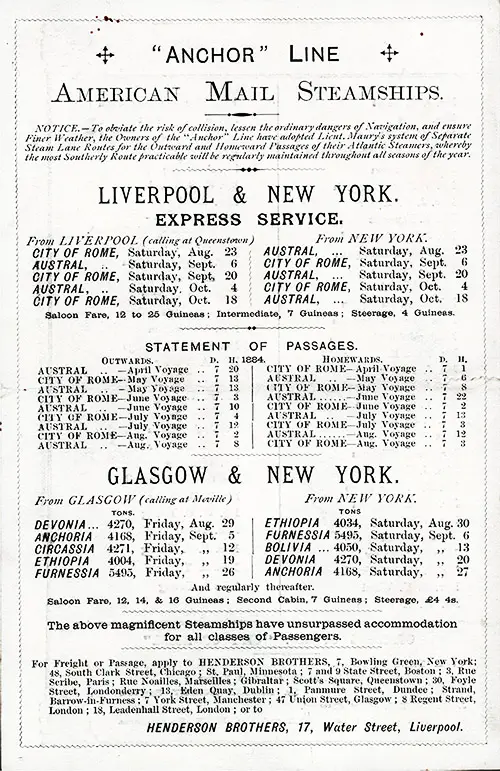
Anchor Line Services on the Back Cover, SS City of Rome Saloon Class Passenger List, 23 August 1884. | GGA Image ID # 15b76cfaec
📜 Research note: Some names and captions were typed from originals and may reflect period spellings or minor typographical variations. When searching, try alternate spellings and cross-check with related records. ⚓
Curator’s Note
For over 25 years, I've been dedicated to a unique mission: tracking down, curating, preserving, scanning, and transcribing historical materials. These materials, carefully researched, organized, and enriched with context, live on here at the GG Archives. Each passenger list isn't just posted — it's a testament to our commitment to helping you see the people and stories behind the names.
It hasn't always been easy. In the early years, I wasn't sure the site would survive, and I often paid the hosting bills out of my own pocket. But I never built this site for the money — I built it because I love history and believe it's worth preserving. It's a labor of love that I've dedicated myself to, and I'm committed to keeping it going.
If you've found something here that helped your research, sparked a family story, or just made you smile, I'd love to hear about it. Your experiences and stories are the real reward for me. And if you'd like to help keep this labor of love going, there's a "Contribute to the Website" link tucked away on our About page.
📜 History is worth keeping. Thanks for visiting and keeping it alive with me.
