
RMS Vaderland Passenger List - 16 September 1911
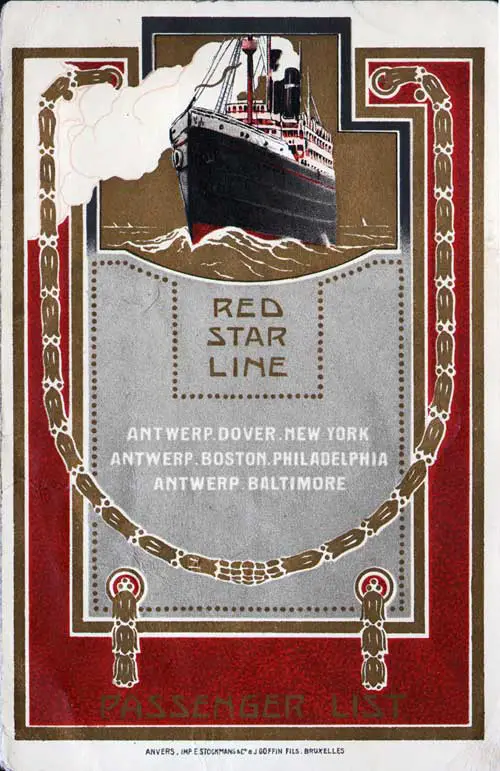
Front Cover of a First Class Passenger List for the RMS Vaderland of the Red Star Line, Departing Saturday, 16 September 1911 from Antwerp to New York via Dover, Commanded by Captain R. Prager. | GGA Image ID # 1df2fdb503. The Image Features a Collection of Text Elements Related to Locations Such As Antwerp, Dover, New York, Boston, Philadelphia, and Baltimore. the Use of “Red Star Line” Suggests a Theme Related to Transportation or Shipping. Additionally, There Is a Mention of “Passenger List,” Which Could Indicate That the Context Involves a List of Passengers. the Photo May Be Presented in a Decorative Picture Frame.
Original First-Class Passenger List for the RMS Vaderland of the Red Star Line, departing Saturday, 16 September 1911, from Antwerp to New York via Dover, commanded by Captain R. Prager.
This is a display-worthy Edwardian-era artifact: a bold, typography-driven front cover design naming major Atlantic gateway cities (Antwerp, Dover, New York, Boston, Philadelphia, Baltimore)—a built-in "route poster" feel that collectors love. The piece is further elevated by its Belgian lithographic pedigree, credited to Imp. E. Stockmans & Co., Anvers and J. Goffin Fils, Bruxelles. 🖼️🇧🇪
🌍 Voyage Overview (Key Facts)
- Ship: RMS Vaderland
- Steamship Line: Red Star Line
- Class: First Class
- Date: 16 September 1911 (Saturday)
- Route: Antwerp → Dover → New York
- Commander: Captain R. Prager
- Format: One sheet of heavyweight paper, tri-folded into panels (see specs)
🛳️ About the Ship: RMS Vaderland (Brief Collector Context)
The RMS Vaderland was one of the Red Star Line's notable transatlantic liners, operating the Antwerp–New York corridor that carried a mix of elite travelers, professionals, clergy, and prominent families in the years just before World War I. These voyages are prized by collectors because they document Atlantic high society and professional networks in motion—at the exact moment modern mass travel, communications, and global business culture were accelerating. ⚓📜
🚢 About the Steamship Line: Red Star Line (Brief)
The Red Star Line (Belgian-based, operating out of Antwerp) was a major North Atlantic carrier, well-known for moving both prestige passengers and the broader tide of transatlantic travelers. Red Star Line ephemera is highly collectible for its graphic design, strong port identity (Antwerp), and enduring association with the classic North Atlantic crossing era. 🌊🧳
Senior Officers and Staff
- Captain: R. Prager
- Surgeon: Ur M. Bertrand
- Purser: J. Caporin
- Chief Steward: C. Jeppesen
🎨 Cover & Design Highlights (Why This One Pops) 🖼️
✅ Front Cover
- A text-rich, city-forward design emphasizing major ports and U.S. destinations: Antwerp, Dover, New York, Boston, Philadelphia, Baltimore
- Presented as if in a decorative picture frame, giving it a "display poster" feel
- Lithographer credits: Imp. E. Stockmans & Co., Anvers & J. Goffin Fils, Bruxelles (excellent provenance for Belgian commercial art printing)
✅ Back Cover
- Bold flag motif featuring a red star (classic Red Star Line branding)
- Passenger annotation: "VADE" written at the bottom (adds human touch and provenance)
👑 VIPs & Notable Passengers (Extracted Highlights)
A curated selection of the most research-worthy names on this voyage:
🎬 Entertainment / Early Film (Silent Era) ⭐
- Mr. Robert Frazer — prominent American silent film leading man, appearing in 200+ films; known for early screen roles including an early Robin Hood portrayal. 🎥
- Mrs. Frazer (Mildred Bright) — stage and early film actress; strong early 1910s theatre/film crossover interest. 🎭
🎭 Performance / Vaudeville & Popular Culture
- Mr. George A. Whiting — vaudeville performer and lyricist, best known for writing lyrics to "My Blue Heaven." 🎶
- Mrs. Whiting (Sadie Burt Whiting) — performance-world tie-in (great for entertainment-history collectors).
🎓 Academia / Intellectual Life
- Mr. A. Shulsinger (Arthur M. Schlesinger Sr.) — historian; taught at Harvard University and a major figure in developing modern social/urban history. 📚
- Mr. Kenneth McKenzie — romance-language scholar; taught at Yale University and later led modern language work at the University of Illinois (excellent "education history" lead). 🎓
- Mr. Wm. P. Trent — Professor of English Literature, Columbia University (major American literary scholarship figure). ✍️
⛪ Religious Leadership
- Rev. Joseph Cunneely — "Right Rev." / Monsignor-level Catholic leadership; longtime rector of Holy Trinity Church, Hackensack, NJ, a major parish builder (school, convent, large church project). ⛪
- Rev. James Franz — clergy traveler (often connected to transatlantic church networks and speaking circuits).
🗳️ Reform / Women's Civic & Social History
- Mrs. H. D. Hooker, Jr. (Edith Houghton Hooker) — influential suffragist and organizer in Maryland; founded the Just Government League and launched Maryland Suffrage News. 🗳️👒
- Miss Helen J. Almy (Helen Jackson Cabot Almy) — Boston civic leader involved in early playground/vacation school movements and settlement-house work (Cambridge civic history). 🏙️
🩺 Medicine / Public Health
- Dr. Thos. E. Satterthwaite — connected to early children's hospital initiatives and public-health philanthropy; medical-history relevance. 🩺
- Dr. S. E. Simmons — physician traveler (research lead).
- Mr. D. P. Fackler — prominent American actuary/statistical professional; founding leadership in actuarial societies (finance-history angle). 📈
📰 Journalism / News Industry Power
- Mr. Frank B. Noyes — President of The Washington Star and early President of The Associated Press (huge U.S. media history relevance). 🗞️
- Newbold Noyes — Washington Star editorial family line (research magnet).
🌍 Diplomacy / International Affairs
- Mr. Wm. Rappard (William E. Rappard) — Swiss academic and diplomat associated with international institutions (League of Nations-era significance). 🌐
List of First Class Passengers
- Miss Helen J. Almy (Note 1)
- Miss Mary Angeonie
- Arnold Aronovice
- Mrs. W. P. Atwell
- Mrs. Dale Bakewell (Leila Semple Bakewell 1866–1924)
- Miss Hazel Bakewell (Hazel Bakewell Fellner 1892-1974)
- Mr. P. Bonner Bakewell (Paul Bonner Bakewell 1894-1973)
- Mr. Ralph B. Bettmann
- Mr. C. W. Booth
- Mr. Wilhelm Brecke
- Mr. D. E. Brown
- Mr. J. B. Byrne
- Mrs. Byrne
- Mr. Merritt T. Cooke (Note 2)
- Mrs. Cooke
- Miss Eliz. E. Cooke
- Mrs. A. G. Crawford
- Miss Marg. Crawford
- Rev. Joseph Cunneely (Note 3)
- Miss Herma Dalossy
- Mrs. Wm. B. Davenport
- Mrs. E. W. Dayton
- Mr. Jack W. Dayton (John William "Jack" Dayton, 1898–1989)
- Mr. Wm. De Wolf-Dimock
- Mrs. De Wolf-Dimock
- Miss Emily C. Dimock
- Mr. Willi Diebel
- Mrs. E. C. Dillingham
- Miss Alice Dillingham
- Miss Josephine Doorley
- Mr. E. B. Dustan
- Mrs. E. W. Dustan
- Mr. D. P. Fackler (Note 4)
- Miss E. D. Fackler
- Mr. H. Feremans
- Mrs. Feremans
- Miss Elizabeth Fisher
- Mr. J. B. Fletcher
- Mrs. Fletcher
- Miss Margaret Fletcher
- Master Jefferson Fletcher
- Rev. James Franz
- Mr. Robert Frazer (Note 5)
- Mrs. Frazer (Mildred Bright (Note 6)
- Mr. Jose E. Gonzalez
- Mrs. Gonzalez
- Miss Jula Gonzalez
- Miss Luz Gonzalez
- Mrs. Louise Gress
- Miss Elsie Heil
- Miss Laura Hellmann
- Mr. Southmayd Henderson
- Mrs. Henderson
- Miss Josephine Henderson
- Mr. Theo. Heinrich
- Mr. R. Randolph Hicks
- Mrs. Hicks
- Mr. S. M. Hohl
- Mrs. H. D. Hooker, Jr. (Note 7)
- Mr. Hooker, Jr.
- Miss Johnson
- Mr. Robert N. Kenyon
- Mrs. Kenyon
- Miss Anna B. Kerr
- Miss Elenor Kerr
- Mr. H. Irvine Keyser (Note 8)
- Mrs. Keyser (Note 9)
- Miss Ann Franklin Keyser (Later Mrs. DeCourcy W. Thom)
- Mr. Wm. T. Kuhns (Note 10)
- Mrs. Kuhns
- Miss Margaret Kuhns
- Miss Elizabeth Kuhns
- Miss Helene La Bonte
- Mrs. C. H. Lang
- Miss Edith L. Lang
- Mrs. W. Le Cerff
- Mr. Frank Le Cerff
- Miss Laurentine Le Maire
- Mrs. Susan E. Leves
- Mrs. R. M. Lowe
- Mr. Gilbert R. Lowe
- Miss Marie McGuire
- Mrs. M. H. Mackay (Note 11)
- Mr. Kenneth McKenzie (Note 12)
- Mrs. McKenzie
- Miss Mary J. McNulty
- Mr. Ludwig F. Maierle
- Dr. Byron E. Miller
- Mrs. Miller
- Mr. E. C. Mix
- Mrs. Mix
- Miss Alvina Moehle
- Miss Ella F. Moore
- Miss L. R. Morris
- Mrs. Herbert Myrick (Note 13)
- Miss Christine Myrick
- Mr. John L. Newbold (Note 14)
- Mrs. Newbold
- Master John L. Newbold, Jr. (Note 15)
- Mrs. Charles Newbold
- Mr. Frank B. Noyes (Note 16)
- Mrs. Noyes (Note 17)
- Mr. Newbold Noyes (Note 18)
- Mr. Wm. T. Nuttall
- Mr. C. A. O'Connor (Note 19)
- Mrs. George F. Parmelee
- Miss Virginia T. Peacock (Note 20)
- Miss Sarah B. Peacock
- Miss Victoria Peacock
- Miss Lucy W. Perry
- Mr. A. Hulshoff Poll
- Mr. Edward Ponsland
- Mrs. Pauline S. Proctor
- Mr. Oscar S. Proctor
- Mr. Wm. Rappard (Note 21)
- Mrs. Rappard
- Master Max Rappard
- Master Charles Rappard and Maid
- Miss Evelyn Riddle
- Mrs. George W. B. Roberts
- Miss Edith L. Roberts (Note 22)
- Miss E. B. Roberts
- Miss D. M. Roberts
- Miss Virginia Roberts
- Dr. Thos. E. Satterthwaite (Note 23)
- Mrs. Satterthwaite and Maid (Note 24)
- Mr. Townsend Scott
- Mrs. Scott
- Miss Helen T. Scott
- Miss Gwendolyn T. Scott
- Mr. Townsend Scott, Jr.
- Mrs. Jette Silbermann
- Dr. S. E. Simmons
- Mrs. Simmons
- Master Bradford Simmons
- Miss Elizabeth Simmons and Governess
- Mr. A. Shulsinger (Note 25)
- Mr. W. H. Singer (Note 26)
- Mrs. Singer (Note 27)
- Miss Lillian Smith and Maid
- Mr. R. W. Springer
- Mrs. Springer
- Miss C. Springer
- Master E. Springer
- Mr. Thos. J. Stewart (Note 28)
- Mrs. N. B. Stewart
- Master Gordon Stewart
- Miss Mary Washington Stewart
- Mr. John Stewart
- Mrs. Chas. N. Stokes
- Miss Hazel J. Stokes
- Miss Gertrude A. Stone
- Mr. Charles F. Sulzer
- Mrs. Isabel H. Sutliff
- Isabella Taylor
- Mr. De Courcy Thom (Note 29)
- Mrs. Thom
- Miss Mary Gordon Thom (1892-1975)
- Mr. Geo H. Thomas
- Mr. Henry Thompson
- Mrs. Thompson
- Miss Katherine M. Thompson
- Mr. R. D. Totten (Robert Duncan Totten 1866-1925)
- Mrs. Totten (Elisabeth Reymer Totten 1868-1955) and Maid
- Miss Eliz Totten (Elisabeth Riter Totten Isham 1894-1986)
- Miss Phyllis Totten (Phyllis Reymer Totten 1902-1988)
- Miss Louise Totten (Louise Mellier Totten Coney 1902-1960)
- Mrs. B. P. Traitel (Mrs. Bernard P. Traitel / Alida Loeb 1862-1942)
- Miss Ruth Traitel (Ruth Traitel Guiterman 1890-1956)
- Mr. Wm. P. Trent (William Peterfield Trent (Note 30)
- Mrs. Trent (Alice Lyman)
- Master Wm. P. Trent, Jr. (Note 31)
- Miss Lucia Trent (Note 32)
- Mrs. Archibald Turner
- Mr. George Turner
- Mrs. Turner
- Dr C. W. A. Veditz
- Mrs. Veditz
- Master Jean Veditz
- Miss Florence von Sickler
- Miss Mary L. Wallace
- Miss E. B. White
- Mr. George A. Whiting (George A. Whiting (Note 33)
- Mrs. Whiting (Sadie Burt Whiting)
- Miss Ellena Custus Whiting
- Master Lawrence L. Whiting and Maid
- Miss Mary B. Wilson
- Mrs. Fredk. Wood
- Miss Margaret Wood
- Miss Eleanor K. Wood
- Miss Louisa Zurcher
Notes About First Class Passengers
- Helen Jackson Cabot Almy, (1856-1938) was a prominent Bostonian who was the daughter of Samuel and Hannah Lowell (Jackson) Cabot, and later became the wife of a judge, Charles Almy. A member of the Mothers' Club of Cambridge, she was active in establishing playgrounds and vacation schools in Cambridge from 1899 to 1910, when the city took over the program. Mrs. Helen Cabot Almy, director of the Cambridge Neighborhood House, oldest settlement house in the world. She became the wife and later the widow of Judge Charles Almy, a justice of the Third District Court of Eastern Middlesex County for 30 years. Mrs. Almy was a director of the Cambridge School and served as the chairman of a women's committee that established the first public playgrounds in Cambridge many years ago. She was also a director of the Cambridge Red Cross and the Cambridge League of Women Voters. She was the founder of the mothers' conferences at the Cambridge Neighborhood House. At her death, she was a member of the Cambridge Park and Recreation Commission.
- Merritt Todd Cooke Jr., 1884–1967) was an American football player, coach, engineer, and banker. He served as the head football coach at the University of Virginia in 1908, compiling a 7–0–1 record. Cooke graduated from the University of Virginia in 1906. He played on the football team for four years, from 1903 to 1906. In 1910, Cooke was working as an electrical engineer. By 1921, Cooke had moved to Chestnut Hill, Pennsylvania, to work as an engineer for Baer, Cooke and Co. He was working as an investment banker in Philadelphia by 1931. He was educated at the University of Virginia, graduating in 1906.
- The Right Rev. Joseph J. Cunneely, N. F. (1854-1929), dean of Roman Catholic priests of Bergen County and for thirty-eight years rector of Holy Trinity Church, Hackensack, NJ. Mgr. Cunneely developed a large parish during his priesthood, built a parochial school and lyceum, a new rectory, and a convent. He also had a new church erected at a cost of about $500,000. Just eighteen days ago, the edifice was dedicated by Bishop Walsh of Newark, assisted by many State dignitaries: It had been Mgr. Cunneely's one wish that he might be instrumental in the building of a new church and live to see it dedicated.
- David Parks Fackler (1841–1924) was an American actuary. He was raised in New York City and attended the City College of New York, graduating in 1859. Fackler worked at the Mutual Life Insurance Company of New York under Sheppard Homans Sr., and later resigned to become a consulting actuary. He was a founding member and second president of the Actuarial Society of America. In 1914, Fackler was named an inaugural fellow of the American Statistical Association.
- Robert Frazer (1891–1944) was a prominent American actor during the early 1900s, recognized as a leading man in silent films. Born Robert William Browne in Worcester, Massachusetts, he began his film career around 1912. He appeared in over 200 films, beginning with Eclair, which was distributed by Universal Pictures. He is noted as the first to portray Robin Hood on film, in the 1912 version. He played Jesus Christ in The Holy City (1912) and appeared in Rob Roy (1913). Before his film success, he performed with several repertory companies, including the Cosgrove Stock Company, and appeared on Broadway in Seremonda (1917). While he was a leading man in the silent era, he successfully transitioned to character parts, often playing villains in "Poverty Row" westerns during the sound era. He was known for his work in The Vampire Bat (1933) and White Zombie (1932).
- 1892-1967) was an American actress active in the early 1900s, known for her stage work in musicals like The Merry Countess (1912) and early silent films such as The Witch (1913) and The Electric Girl (1914), appearing in a dozen or so films before fading from prominence as sound films emerged, with her career bridging theatre and silent cinema. She was in the chorus of Girlies (1910) and The Merry Countess (1912) on Broadway. Her film career began in earnest around 1913-1914, with roles in The Witch, Rob Roy, The Snake Charmer, and The Electric Girl, among others. While she had a presence in early film, her career didn't transition into the sound era as prominently as some contemporaries, with her last known roles being in the 1920s. She was married to Robert Frazer.
- Mrs. H. D. Hooker, Jr. refers to Edith Houghton Hooker (1879-1948), a prominent suffragist and social worker who married Dr. Donald Hooker (H.D. Hooker, Jr.) and was active in Maryland, organizing the Just Government League (1909) and Maryland Suffrage News (1912). Born Edith Houghton, she married Dr. H.D. Hooker (Donald Hooker). Organized the Just Government League in 1909, affiliated with NAWSA. Founded the official organ of the suffrage movement, Maryland Suffrage News (1912). A Bryn Mawr graduate and one of the first women at Johns Hopkins Medical School. Edith was a critically important and arguably essential figure in the Maryland campaign for women's suffrage. Without her drive and dynamism, we would have little awareness of Maryland suffragists' commitment to achieving the right to vote. Edith Houghton graduated from Bryn Mawr College and enrolled in the Johns Hopkins University Medical School, one of the first women accepted into that program. Following her marriage to Dr. Donald Hooker and a year of study in Berlin, she returned to Baltimore and began a career in social work. Edith Houghton Hooker died on October 23, 1948. She was inducted into the Maryland Women's Hall of Fame in 1999.
- H. Irvine Keyser (Henry Irvine Keyser, 1837-1916) was a prominent Baltimore businessman and banker, deeply involved in Maryland's civic and social life, known for his leadership in finance and his wife's notable genealogical work, with his life spanning the late 19th and early 20th centuries, dying in 1916 at his country home, Westmoreland near Eccleston. He was a significant figure in Baltimore's banking and business circles for over 50 years. Married to Mary Ann (Washington) Keyser in 1864, they were active in Baltimore society, hosting at their town and country homes. His wife, Mary Ann (Washington) Keyser, was a noted genealogist, and they left a significant mark on Baltimore's historical and social fabric.
- Mary Ann Washington Keyser 1841-1931) and Maid (Mrs. Keyser was a direct lineal descendant of the Colonial family Washington, through John Augustine Washington, brother of the first President, and his half-brother William Augustine Washington. Mrs. Keyser took great interest in the genealogy of her family and other early Colonial families, and she collected portraits and ancestral belongings of the Washington family. She was one of the founders of Chapter 1 of the Society of Colonial Dames of America. She served for many years as its president and during her tenure in this office was one of the principal collectors of data for and sponsor of the publication of the genealogical and historical work, Ancestral Records and Portraits.
- Mr. Wm. T. Kuhns, or William Theodore Kuhns (1854-1938), was a prominent Atlanta photographer in the early 20th century, part of a significant family dynasty of photographers, including his father William A. Kuhns and siblings, who ran studios in Atlanta, often under names like "Kuhns & Son" or "Kuhns' Photograph Gallery," specializing in portraits and artistic photography, leaving a rich legacy of Southern photographic history. He was the son of William A. Kuhns (1824-1905) and was part of a larger family of photographers, including his brother, Julius H. Kuhns, and sister, Isabella E. Kuhns, who all worked in the family business in Atlanta. They were known for portraiture, often featuring elegant studio settings, and produced ambrotypes, tintypes, and cartes de visite, capturing Atlanta's growing population. Their work provides valuable insight into Atlanta's social history and photographic development, especially after the Civil War.
- Likely Mary Henderson Mackay was the wife of journalist and historian, George Mackay, and the daughter of Rev. Dr James Nish, first Presbyterian Minister of Bendigo.
- Kenneth McKenzie 1870-1949) was born in Cambridge, Mass., where his father, the Reverend Dr. Alexander McKenzie, an eminent divine, was long-time pastor of the Congregational Church by the Commander Elm and long-time member of the Board of Overseers of Harvard University. The younger McKenzie's interests were quickened, particularly in poetry and music at home and by visits to Europe, so that by the time he entered Harvard in the class of 1891, he became organist of his father's church and later specialized in music under John K. Paine, with whom he subsequently made a tour of important European music centers. Upon his return, he resumed his studies at Harvard Graduate School, shifting his interests to modern languages. After instruction under Charles Eliot Norton and E. S. Sheldon, he won the Dante Society prize in 1894 for his essay, "The Rise of the Dolce Stil Nuovo," and won his Ph.D. in 1895 with his thesis on "The Development of Italian Lyric Poetry before the Rise of the Dolce Stil Nuovo." Nor did Professor McKenzie's ever-broadening interests diminish, for in his first position, which he held three years at Union College, he was college organist and choirmaster as well as instructor in German. After a brief stay at the University of West Virginia in 1900, McKenzie became an instructor, then an assistant professor in Romance languages at Yale University, where he remained until he became head of the Modern Language department at the University of Illinois in 1915. In his early days at Yale, he shared a house with Charles Osgood, Douglas Buffum, and others. It was a lieta brigata scholastic. These named were invited among others to become Woodrow Wilson's first 'preceptors' at Princeton University.
- Wife of Herbert Myrick (1861-1927), President of the Phelps Publishing Company of this New York City, and publisher of The New England Homestead. He was educated at the Massachusetts Agricultural College and Boston University. He had been President of the American Education Press and the publisher of many periodicals with primary circulation among farmers and their wives. Among these were The Dakota Farmer, Orange Judd Farmer, Farm and Home, and The American Agriculturist. He was also the publisher of Good Housekeeping from 1900 to 1911 and founded the Good Housekeeping Institute. He had also written books on agricultural topics, particularly those that applied economic theories to the problems faced by agriculture.
- John Lowe Newbold, 1871-1931), a prominent New York City business executive. He was the founder and chairman of the Merchants' Transfer and Storage Company, which he had served as president. In 1924, he became a director of the Federal-American National Bank. He was a brother of Fleming Newbold, business manager of The Evening Star, and of Mrs. Frank B. Noyes, whose husband is president of The Associated Press.
- John Lowe Newbold, Jr., 1905-1981), later became president and chairman of the board of the Merchants Transfer and Storage Co., and a former member of the board of directors of the old District Redevelopment Land Agency. Mr. Newbold was president of Merchants Transfer and Storage, a family business founded in the late 1880s, from 1931 until his retirement in 1975, when he sold the company. He was an officer and director of the National Furniture Warehousemen's Association and United Van Lines and a director of the International Bank of Washington since 1951. From 1959-65, he was a member of the policy-making board of the District Redevelopment Land Agency, the city's urban renewal agency that became part of the D.C. Department of Housing and Community Development in 1975. Mr. Newbold, a native Washingtonian, attended St. Albans School for Boys here and graduated from Yale University. He was commissioned in the Army Reserve in 1933. In World War II, he served as a lieutenant colonel and chief of the procurement section of the Selective Service System and with the Persian Gulf Command.
- Frank Brett Noyes (1863-1948) was a prominent American newspaper executive, serving as President of The Washington Star and the first President (from 1900) of The Associated Press, significantly shaping the modern news agency in the early 1900s, transitioning journalism from partisan to broader coverage while also managing his family's influential newspaper business in Washington DC. Associated Press (AP) President (1900-1938): He was instrumental in establishing the modern AP, leading it through decades of growth and overseeing its transition from a regional wire service to a global news giant, retiring in 1938. The Washington Star: A lifelong connection, he served as manager/treasurer (until 1901) and later as President (from 1910) of the Star, a family newspaper. Chicago Journalism (1901-1910): He lived in Chicago, editing the Chicago Recorder-Herald while maintaining his role with the Star. Transition in Journalism: Noyes helped steer American journalism away from its partisan roots toward more objective, comprehensive news coverage. Born in Washington DC, he began working for The Evening Star as a teenager, rising through its ranks. He married Janet Thurston Newbold in 1888, and they had children, including Frances (author Frances Noyes Hart), Newbold Noyes Sr., and Ethel.
- Janet Thurston Newbold, 1867-1942 m. 1888), was the wife of Noyes Brett Frank, President of the Washington Star & founder of the Associated Press.
- Newbold Noyes Sr. (1892-1942) Associate editor of the Washington Evening Star. He graduated from Yale University. He was a published poet.
- Likely Charles Andrew O'Connor (1854–1928), judge, solicitor, of Acres, Co. Roscommon, was educated at St Stanislaus College, Tullabeg (1865–70), and TCD (BA 1874). There he participated in the College Historical Society, of which he was elected auditor for 1877–8 as a 'home-ruler' in a contest which included Edward Carson (qv). He was called to the bar in 1878 and became a member of the Connacht circuit. Neat, amiable, and naturally courteous, he was a general favorite at the bar and acquired a large chancery practice. He was appointed QC in 1894 and elected a bencher of the King's Inns in 1896. In March 1907, he was appointed third serjeant and succeeded as first serjeant in December 1907. Became Solicitor-General for Ireland in 1909 and Attorney-General in 1911. A prominent figure in Irish politics, serving on university governing bodies.
- Virginia Tatnall Peacock (1873–1918) was an American author and editor active in the early 1900s, best known for her work regarding the lives of19th-century American women. "Famous American Belles of the Nineteenth Century," by Virginia Tatnall Peacock, published by J.B. Lippincott Company in 1900/1901, was a historical account written in the early 20th century. The book explores the lives and societal influences of notable women from the 1800s who were celebrated for their beauty, intellect, and social prowess, reflecting their significant roles in American history. Through their stories, Peacock highlights how these women shaped social and political landscapes, navigating the challenges and opportunities of their time. She was a society editor for the Washington Post and the Washington Evening Star. Born on January 7, 1873, she lived in Washington DC, never married, and passed away suddenly on August 1, 1918. Her work is frequently reprinted today as a significant historical account of American social history.
- William Emmanuel Rappard (1883–1958) was an influential academic and diplomat of the interwar-period, a passionate defender of the international scene. Rappard was as a co-founder of the Graduate Institute of International Studies (now IHEID), Professor of Economic History at the University of Geneva, Rector of the University of Geneva in 1926, Director of the Mandate Section of the League of Nations Secretariat (and as a member of the Permanent Mandates Commission for all 18 years of its active life), and Swiss Representative at the International Labour Organization (ILO), as well as at the United Nations Organization (UN) and at the United States Embassy. Rappard was an assistant professor of economics at Harvard University from 1911 to 1913. In 1913, he became a professor at the University of Geneva. He worked for the League of Nations Secretariat. He resigned from the secretariat in 1924 and became vice-rector at the University of Geneva. He was made an "extraordinary" member of the Permanent Mandates Commission, attending his first session of the Commission in June 1925. He served on the commission for the remainder of his life. According to historian Susan Pedersen, Rappard was the "leading presence" on the commission. Rappard was elected to the American Philosophical Society in 1941. Rappard was a member of various Swiss diplomatic missions, including service with the Swiss delegation to the peace conference in France that ended the First World War. He made a strong impression on President Woodrow Wilson and was highly influential in persuading him to choose Geneva asthe headquarters of the League of Nations beginning in 1920. The headquarters of the World Trade Organization in Geneva, Switzerland (Centre William Rappard, built to house the International Labour Organization) and the Chemin William Rappard in Bellevue, Switzerland, have been named after him.
- Likely Edith Roberts (1898 or 1899–1935) was an American silent film actress from New York City. Roberts was a child actress who performed at the Vaudeville Theatre before moving to Hollywood in 1916. Among her more than 150 screen credits are roles in Seven Keys to Baldpate (1925), Big Brother (1923), The Wagon Master (1929), The Mystery Club (1926), and Two O'Clock in the Morning (1929). Roberts was married to real estate operator Harold Carter. On August 20, 1935, she died shortly after giving birth to a son, Robert, at age 36.
- Dr. Thomas Edward Satterthwaite (1843-1934) became the first director of Babies' Hospital in Oceanic, NJ.
- Mrs. Satterthwaite and the 1887 founding of Babies' Hospital and its "Summer Branch" in Oceanic, NJ were the result of remarkable "women's work." Two unmarried physician sisters, Sarah J. McNutt and Julia G. McNutt, Mrs. Thomas E. Satterthwaite, Mrs. Andrew H. Smith, and Mrs. James Lenox Banks (Maude) worked together to raise sufficient funds to start a hospital dedicated to the care of children. At the time, only 27 hospital beds were available for children among all the hospitals in the city when infectious disease was rampant, and many newly arrived immigrant families were both fecund and poor. Mrs. Satterthwaite was Mr. Banks's sister and probably not too dissimilar in age.
- Arthur Meier Schlesinger, 1888–1965) was an American historian who taught at Harvard University and pioneered social and urban history. He was a Progressive Era intellectual who stressed material causes (such as economic profit and conflict between businessmen and farmers) and downplayed ideology and values as motivations for historical actors. He was highly influential as a director of PhD dissertations at Harvard for three decades, especially in the fields of social, women's, and immigration history. His son, Arthur M. Schlesinger Jr. (1917–2007), also taught at Harvard and was a noted historian.
- Mr. W. H. Singer refers to William Henry Singer, Jr. (1868-1943), an American Impressionist painter and art collector from a wealthy Pittsburgh steel family, who left the family business around 1900 to pursue art, moving to Monhegan Island, Maine, then Europe (Paris, Holland), and finally settling in Norway, becoming known for his luminous landscapes and building the foundation for the Singer Laren museum. Around 1900, Singer left his father's steel company (Singer-Nimick) to fully embrace painting, supported by his wife, Anna, and influenced by mentors such as Martin Borgord. He studied in Paris and then moved to Laren, Holland, painting landscapes in a flowing, light-filled Impressionist style before finding inspiration in Norway's snow scenes and developing a distinct technique. He and Anna became significant collectors, acquiring works by Barbizon School artists, other Americans, and European sculptors, eventually establishing a collection that formed the basis of the Singer Laren. His move to Norway led to his most famous works, and the couple's legacy includes the Singer Museum and Theater in Laren. As Singer reached his late twenties, several events encouraged his artistic aspirations, the most important of which was his marriage to Anne Spencer Brugh in 1895. Anna, as she was called, not only shared his artistic interests but, throughout their long life together, remained his firmest supporter and kindred spirit. During a trans-Atlantic crossing, supposedly Andrew Carnegie encountered Singer's father and urged him to acknowledge his son's talent: "It would be unjust," Carnegie argued, "to keep this talent cooped up in a factory instead of giving it the chance of free development." Singer and his wife left the States with their departure from Monhegan in 1901. He studied abroad, of course, but until 1908, both Singer and his wife returned to the United States almost annually. They would occasionally take up residence in New York City or Old Lyme, Connecticut, at those times. After that, their trips back became less frequent, very often coinciding with Singer's American exhibitions. In addition to an active exhibition schedule in America from 1906 to 1937, his work was shown regularly in the annual Pennsylvania Academy exhibitions, thereby retaining his American audience, with his views first of Holland, and later of Norway.
- In the early 1900s, Anna Spencer Brugh Singer (1873-1962) was a prominent American art collector, patron, and co-founder of museums with her husband, artist William H. Singer, Jr., focusing on Barbizon School art, contemporary American works, and antiques, leaving a legacy through the Washington County Museum of Fine Arts (Hagerstown, MD) and Singer Laren (Netherlands). Born in Hagerstown, MD, she married wealthy artist William H. Singer, Jr. in 1895, becoming his steadfast supporter and fellow art enthusiast. The Singers traveled extensively, collecting art and actively supporting artists, often housing them in their homes in Laren, Netherlands, and Olden, Norway. While their major gifts came later (1931 for WCMFA, 1956 for Singer Laren), their collecting and patronage in the early 20th century laid the groundwork for these institutions, driven by a desire to share art with the public. In 1931, she helped establish the Washington County Museum of Fine Arts (WCMFA) in her hometown, followed by the Singer Laren in the Netherlands, creating lasting cultural centers. Anna Brugh Singer was a pivotal figure in the American art world of the early 20th century, using her wealth and vision to build significant art collections and transform them into public treasures.
- Thomas Jameson Stewart (1848–1917) was an Irish-born American politician and military officer who served as Secretary of Internal Affairs of Pennsylvania from 1887 to 1895 and Adjutant General of Pennsylvania from 1895 until his death in 1917.
- William Henry DeCourcy Wright Thom (1858–1932) was a prominent American broker, author, and civic leader based in Maryland, active during the early 1900s. He was a retired broker and served as vice-president of the Maryland Historical Society. He was the originator of the Maryland Historical Society's magazine and was a leader in establishing the Society for the Preservation of Maryland Antiquities. In 1908, he delivered a noted address regarding Cecil Calvert (Maryland history). He was heavily involved in public service, serving as chairman of the Maryland Bicentennial Commission. He authored Midsummer Motoring in Europe, a travelogue published in 1916 that chronicled his travels across Europe at the time. He was part of a long line of Maryland/Virginia public servants; his son, DeCourcy Wright Thom Jr., was born in 1915.
- 1862-1939) was a significant Professor of English Literature at Columbia University from 1900 to 1929, known for his influential scholarship, founding the Sewanee Review, and being instrumental in bringing him to Columbia, a move supported by President Theodore Roosevelt. He was a respected author and editor, contributing to American literary studies and editing works on John Milton, and his tenure at Columbia marked a notable period for English studies there. Professor of English Literature at Columbia (1900-1929). Founded the Sewanee Review in 1892, a literary journal still published today. Authored books on William Gilmore Simms, Robert E. Lee, John Milton, and American literature, and co-edited Milton's complete works. Connection to Theodore Roosevelt: President Roosevelt helped recruit him to Columbia due to his literary reputation. Mr. Trent was a prominent literary scholar and educator who significantly shaped English studies at Columbia University in the early 20th century. For more than twenty years, Dr. Trent was engaged in preparing an exhaustive biography and bibliography of Defoe in ten manuscript volumes. The work was completed a few years ago and is being edited by Henry C. Hutchins in the library's rare book room at Yale University. More recently, Dr. Trent completed "Memoirs" and "Thoughts on Teaching," both of which will be published posthumously. He received his M.A. degree from the University of Virginia in 1884 and his LL.D. from Wake Forest College in 1899. The University of the South conferred the degree of D.C.L. on him in 1905. Others of Dr. Trent's literary works included "Southern Statesmen of the Old Regime," "Robert E. Lee," "John Milton, A Short Study of His Life and Works," "War and Civilization," "The Progress of the United States in the Eighteenth Century," "History of American Literature," "Great- ness in Literature" and "Longfellow and Other Essays." At his death, Dr. Trent had planned a series of studies based on his class notes covering seventeenth-, eighteenth-, and nineteenth-century literature. He had also just completed a book to be published in the Christmas season of 1940 under the title, "Te Deum Critical Appreciation."
- William P. Trent Jr. (1902-1972), a New York cartoonist. By the time he and the 20th Century both hit their 20s, he was contributing cartoons to major magazines. Life, Judge, The Saturday Evening Post, Country Gentleman, The New Yorker, Collier's, and other magazines were among those publishing his cartoons.
- Mrs. Lucia Trent Cheney, author of several volumes of poetry. Lucia Trent (later Lucia Trent Cheyney) was an American poet, editor, and activist prominent in the early-to-mid 20th century, known for her socially conscious poetry and for her contributions to the literary scene in San Antonio, Texas. Trent wrote provocative poetry addressing social justice issues, including anti-lynching, the struggles of "the ghetto," and critiques of capitalism's impact on women and families. Around 1926, she married Ralph Cheyney, a fellow poet with whom she collaborated closely. Together, they edited the literary magazine Contemporary Vision and co-edited the 1929 anthology America Arraigned!, which featured poetry about the Sacco and Vanzetti trial. She and her husband wrote More Power to Poets: A Plea for More Poetry in Life, More Life in Poetry (1934). Her work was recognized for its radical and political nature during the Depression-era US, and she was considered a significant enough figure that W.E.B. Du Bois requested permission to quote her. She and her husband, Ralph Cheyney (who died in 1941), were central figures in the San Antonio arts scene. In the 1930s, some considered her to be the best female poetry reader of the time.
- 1884–1943) – Vaudeville Performer. Born in Chicago, he was a well-known vaudeville song-and-dance man and lyricist. He was active during the early 1900s vaudeville era, touring with his wife, singer Sadie Burt. He is best known for writing the lyrics to "My Blue Heaven" (music by Walter Donaldson).
*********** Passenger identifications are considered "probable" based on matched names, dates, and careers. ***********
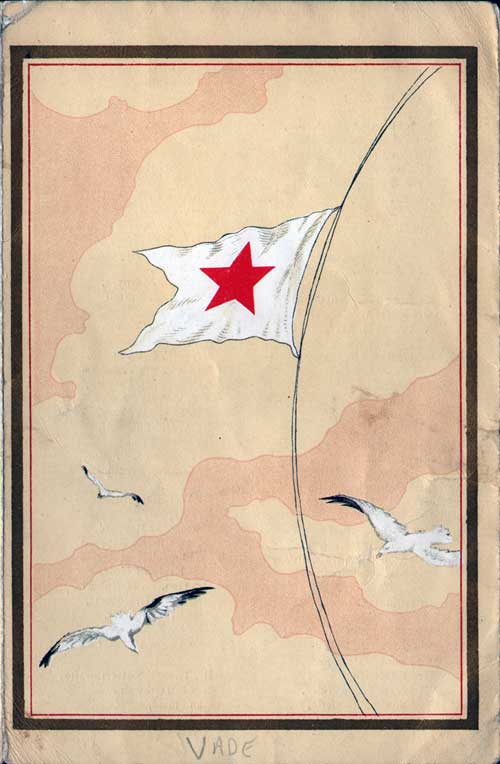
Back Cover of the SS Vaderland First Class Passenger List from 16 September 1911. The Image Features a Flag Prominently Displaying a Red Star. It Is Associated With the Content Labeled “Vade” Written on the Bottom by the Passenger. the Artwork Encompasses Various Forms, Including Painting, Drawing, and Sketching, Suggesting It May Reflect Watercolor Art Styles and Is Likely Presented in a Picture Frame. | GGA Image ID # 21b815a545
📏 Document Specifications
- Format: One sheet of heavyweight paper, tri-folded into panels
- Binding: None (folded sheet)
- Pages/Panels: 4 excluding covers (panel-style layout)
- Panel Size: 12.2 cm W x 18.7 cm H
- Full Sheet: 36.6 cm W x 18.7 cm H
📜 Research note: Some names and captions were typed from originals and may reflect period spellings or minor typographical variations. When searching, try alternate spellings and cross-check with related records. ⚓
Curator’s Note
For over 25 years, I've been dedicated to a unique mission: tracking down, curating, preserving, scanning, and transcribing historical materials. These materials, carefully researched, organized, and enriched with context, live on here at the GG Archives. Each passenger list isn't just posted — it's a testament to our commitment to helping you see the people and stories behind the names.
It hasn't always been easy. In the early years, I wasn't sure the site would survive, and I often paid the hosting bills out of my own pocket. But I never built this site for the money — I built it because I love history and believe it's worth preserving. It's a labor of love that I've dedicated myself to, and I'm committed to keeping it going.
If you've found something here that helped your research, sparked a family story, or just made you smile, I'd love to hear about it. Your experiences and stories are the real reward for me. And if you'd like to help keep this labor of love going, there's a "Contribute to the Website" link tucked away on our About page.
📜 History is worth keeping. Thanks for visiting and keeping it alive with me.
