
RMS Lucania Second Class Passenger List, 4 July 1896 – New York to Liverpool
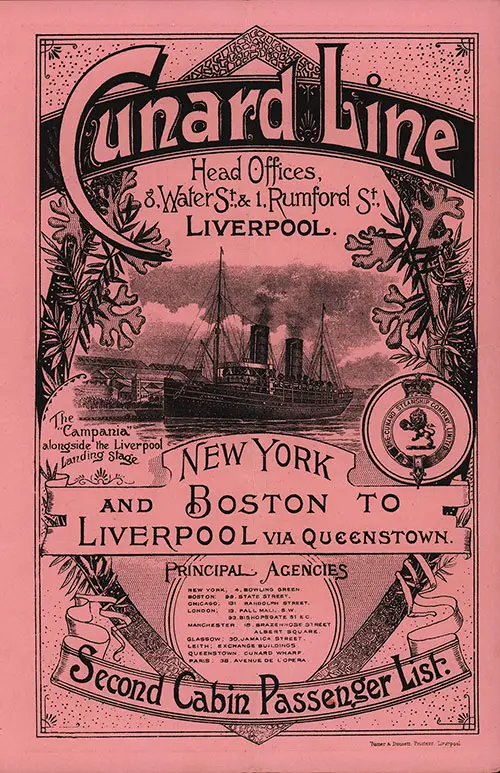
Front Cover of a Second Class Passenger List from the RMS Lucania of the Cunard Line, Departing 4 July 1896 from New York to Liverpool, Commanded by Captain Horatio McKay. | GGA Image ID # 2381820308
Senior Officers and Staff
- Commander: Captain Horatio McKay (LT, R.N.R.)
- Surgeon: James Pointon
- Purser: Wm. Field
- Chief Steward: Henry Clark
Second Class Passengers
- Mr. A. A. Ainsworth
- Mrs. A. A. Ainsworth
- Mrs. W. Allsopp
- Mr. Henry Archibald
- Mrs. Henry Archibald and infant
- Master Thos. Archibald
- Mr. James Allsopp
- Mr. R. W. Allen
- Mr. John J. Allen
- Mr. Robert J. Allen
- Mrs. M. Bave
- Mr. Leo Burn
- Mr. Ed. W. Ball
- Mr. Thomas Burgess
- Mr. John Baxter
- Prof. M. D. Boeckman
- Mr. David Bell
- Mr. W. J. Bowen
- Mr. Thos. W. Brown
- Mr. F. E. Baker
- Mrs. F. E. Baker
- Miss Bates
- Mrs. Bates
- Miss Lucy Barrand
- Miss Mabel Buckley
- Mrs. Mary Banks
- Mr. Michael Buckley
- Mr. S. Bryan
- Mr. F. A. Bell
- Mrs. F. A. Bell
- Mrs. Bates and infant
- Miss Bates
- Mr. Andrew Bires
- Miss E. A. Boardman
- Mr. W. W. Craig
- Mr. John Crotty
- Mr. Wm. Cook
- Mr. Geo. F. Calder
- Mr Jas. F. Crudginton
- Mr. Herbert Corby
- Mr. Daniel Campbell
- Miss Nora Cole
- Mr, Owen Corrigan
- Mrs. Emma Currie
- Miss Violet A. Currie
- Mr. Robert Clark
- Miss Kate Clark
- Mr. Thomas Chalmers
- Capt. H. Carns
- Mr. Robert Clarke
- Miss Julia Cronin
- Mrs. Clarkson
- Mr. Alfred Crew
- Mrs. Alfred Crew
- Miss Ethel Crew
- Master Conrad Crew
- Master Alfred Crew
- Master Chas. Crew
- Rev. Lawrence Cosgrove
- Mrs. James Carmichael
- Mr. James Carmichael, Jr.
- John Cowlishaw
- Miss Cath. Donnelly
- Mr. Daniel Dunn
- Mr. Ed. L. Dunn
- Mr. Wm. Duff
- Miss Annie Docker
- Mrs. T. J. Davis
- Miss Davis
- Mr. John Davis
- Mr. T. J. Davis
- Miss Louise Dart
- Mr. Chas. Drury
- Mr. John Dunbar
- Mr. Chas. Drury
- Mr. Mattew Donnelly
- Mr. A. C. Drate
- Mrs. Jno. Dunbar
- Miss Sarah A. Evans
- Mr. Thos Evans
- Mrs. Thos. Evans
- Miss Maude M. Earle
- Mrs. A. B. Earle
- Mr. H. L.. Erskine
- Mrs. H. D. Evans
- Master Harold Evans
- Miss Irene Fort
- Mr. A. M. Fitzgerald
- Miss Mary Fogerty
- Mr. T. Foster
- Mr. Whipple M. Follett
- Mrs. Whipple M. Follett
- Mr. James Fowell
- Mr. Eli Freeman
- Mr. Wm. H. Flat
- Mr. Wm. Frizzell
- Mr. Geo. Ferguson
- Mr. J. Founders
- Mr. P. Foley
- Mr. M. J. Geary
- Mrs. M. J. Geary
- Mr. James Gibbons
- Mr. Henry Greenwood
- Mrs. Henry Greenwood
- Mr. E B Green
- Miss Kate D. Gilbert
- Miss Ellen Gifford
- Miss Agnes Gifford
- Mr. Fred. Gray
- Mr. W. H. Guy
- Mrs. W. H. Guy, and child
- Mr. Samuel P. Griffin
- Miss Goodfellow
- Mr. Alfred Goodfellow
- Mrs. John J. Hardy
- Mr. Wm. Harbonier
- Mr. H.A. Hartley
- Miss M. R. Hanion
- Mr. Isaac Hardy
- Mrs. Isaac Hardy
- Mr. Jas. A. Hemingway
- Rev. W. E. Hobbs
- Mr. Hawkins
- Mr. E. P. Harrington
- Mrs. Neil Head
- Mr. Neil Head
- Mr. Chas. A. Hamilton
- Miss Minnie Hughes
- Miss Maggie Hannifan
- Miss Mary Hurlihy
- Mr. Wm. Hughes
- Mr. James Horler
- Mrs. James Horler
- Mr. John J. Hardy
- Mr. Jos. Hefter
- Mr. Robt. Isherwood
- Mrs. Robt. Isherwood
- Master Leon'd Isherwood
- Master Lester Isherwood
- Mr. Johst
- Miss Mary E. Jones
- Mrs. Richard Jones
- Rev. R. A. Jones
- Mr. E. F. Keller
- Mr. A. Kitchen
- Mr. P. J. Kelly
- Mr. James Lamb
- Mrs. James Lamb
- Mr. James Lord
- Mr. Wm. Lord
- Mrs. Jane Long
- Mr. Wm. Langley
- Mr. J Littlejohn
- Miss Laura Lake
- Mrs. A. Lake
- Miss Lange
- Miss Mary Langley
- Mr. Wm. Lingbery
- Mrs. Wm. Lingbery
- Mrs. A. T. Lane
- Mr. Chapman Marks
- Mr. Daniel Morrison
- Mr. Morgan R. Morgan
- Mr. John McCartney
- Mr. James McNaughton
- Mr. P. McCabe
- Mr. Wm. Mason
- Mrs. Wm. Mason
- Mr. Jas. McElroy
- Mr. Jose Maurina
- Mrs. Emma Middleton
- Master W. Middleton
- Miss Mary Macken
- Mrs. Mary Morris
- Miss Mellor
- Mr. D. Y. Melleo
- Mr. Jas. Mackin
- Mr. Daniel Mungall
- Mr. James Mungall
- Mr. Jas. McElroy
- Rev. McTavish
- Mr. Wm. Morgan
- Miss Sarah Nolan
- Mr. A. H. Norman
- Mr. James Naughton
- Mr. Chas. Norman
- Mr. Henry Naismith
- Mrs. L. E Norman
- Miss Maria A. Nealy
- Miss Lizzie Nelson
- Mrs. P. J. O'Connor
- Miss Osborn
- Miss Kate O'Keefe
- Miss Annie O'Conneil
- Miss Kate O'Rorke
- Mr. D. H. Oliver
- Mr. E. H. Primin
- Miss Catharine Purcell
- Mr. F. Prange
- Mrs. Ann Pomfret
- Miss S. O. Pickering
- Mrs. A. Parry
- Miss Parting
- Miss Mary Reilly
- Miss S. A. Rowe
- Mrs. Sarah Richards
- Miss Mary Robinson
- Mr. A. C. H. Russell
- Mr. Duncan Ross
- Mr. Edward Rouse
- Mr. Wm. Rannie
- Mrs. Ratcliffe
- Miss Mary Reilly
- Miss P. Rogers
- Miss H. M. Ryan
- Miss V.A. Shaw
- Mr. Jas. Sheeran
- Mrs Jas. Sheeran
- Master Frank Sheeran
- Miss Naggie Sheeran
- Mr. John G. Swann
- Mrs. Mary Stuart
- Mrs. Mary Sherritt and infant
- Mr. E. Siviter
- Mrs. Ernest Schwartz
- Miss Carrie A. Sayre
- Miss Hattie Southall
- Mrs. Susannah G. Southall
- Miss Marian V. Siviter
- Mr. Francis Stones
- Mr. Edwin Serler
- Mr. Jas. E. Spargo
- Geo. F. Scull. Jr.
- Mr. A. W. Smith
- Mr. John Simms
- Mr. Henry Simms
- Mr. L. J. Sullivan
- Miss Hannah Simms
- Miss Louise Stenstrom
- Miss Helen Sullivan
- Mr C. W. Stanard
- Mrs. John Scolley
- Miss Annie Scolley
- Miss Elinor G. Scolley
- Master Herbert H. Shay
- Miss Mary Smith
- Mrs. H. Sharp
- Miss Marian V Siviter
- Rev. McP Scott
- Miss Annie Simms
- Master Leon Schwartz
- Miss Ellen Thomason
- Mrs. Richard Thorp
- Miss H. Thorp
- Miss Jane Toole
- Mr. Jas. Trainor
- Miss Anne Taylor
- Mr. Wm. Torry
- Mrs. Wm. Torry
- Mr. Irving S. Upson
- Mrs. E. A. Walton
- Mrs. M. Wild
- Dr. C. Wild
- Mr. Fred. Wharton
- Mrs. Hlannah Ward
- Mr. Jos. Wilson
- Mr. J. H. Wiison
- Msis A Webster
- Miss L.izzie Webster
- Miss Marian Webster
- Mr. A. H. Wapshare
- Mrs. A. H. Wapshare
- Mr John M. Wells
- Mr. Joseph Walker
- Mr. Albert J. Ward
- Mr. J. Worthington
- Mr. Geo. E. Whitehead
- Mr. Thomas Whitehead
- Mr. W. II. Wilcock
- Mrs. W. H. Wilcock
- Miss Ada B. Wilburn
- Mrs. Fred. Wharton
- Mr. Thos. R. Wade
- Mr A. R. Wade
- Mr. Alex. Wood
- Miss Rose Walsh
- Mr. Wm. M. Wiiliams
- Mrs. Wm. M. Williams
- Mr. H. G. Williams
- Mr. W. G. Wallace
- Mr. S. Walsh
🧭 Voyage Overview – RMS Lucania, 4 July 1896 🇺🇸➡️🇬🇧
This second-class passenger list documents a 4 July 1896 voyage of the RMS Lucania of the Cunard Line, sailing from New York to Liverpool under Captain Horatio McKay (Lt., R.N.R.). It's a mid-summer, post–Gilded Age crossing on one of the fastest and most prestigious express liners in the world, carrying mostly middle-class travelers, professionals, families, clergy, and migrants in second class, the "respectable middle" between opulent saloon and crowded steerage.
The list preserves:
-
Full roster of second-class passengers, including many family groupings
-
Named senior officers (Surgeon James Pointon, Purser Wm. Field, Chief Steward Henry Clark)
-
A beautifully designed front cover, a full two-page name roster, and a back-cover illustration comparing Lucania & Campania to the much earlier Britannia
Because the voyage departed on 4 July, American Independence Day, the list also offers a subtle glimpse of how Anglo-American travel continued right through a major U.S. holiday—useful for classroom discussions of work, leisure, and global mobility in the 1890s. 🎆
🚢 The Ship: RMS Lucania – Cunard's Atlantic Greyhound
The RMS Lucania was one of Cunard's celebrated twin-screw express liners, built by Fairfield Shipbuilding & Engineering Co. for the Liverpool–New York mail route. She was the near-identical sister of RMS Campania; the two ships were, at launch, among the largest and fastest passenger steamers afloat, embodying peak late-Victorian confidence in steam, steel, and speed.
Key points about RMS Lucania:
- Operator: Cunard Line
- Type: Twin-screw express passenger liner (mail steamer)
- Built by: Fairfield Shipbuilding & Engineering Company, Govan, Scotland
- Launched: Early 1893 (sister to Campania, launched in 1892)
- Size & power: Over 12,000 tons and about 620 feet in length, with enormous triple-expansion engines—among the largest of their kind when built.
- Route: Primarily Liverpool – New York express service, carrying both mail and passengers
- Speed & prestige: Lucania captured the Blue Riband for the fastest Atlantic crossing in 1894 and held the title until 1898, making her a true "Atlantic greyhound."
For teachers and students, Lucania is a perfect case study in:
- The transition from paddle to twin-screw steamers
- How the British Admiralty partly subsidized large liners as potential armed auxiliary cruisers
- The symbolism of speed and reliability in the imperial and immigrant age
👥 Social Snapshot: Who Traveled in Second Class?
This 4 July 1896 passenger list shows second class as a socially diverse, but broadly middle-class space:
Family clusters:
The Crew family (Alfred, Emma, Ethel, Conrad, Alfred Jr., and Charles)
The Evans, Greenwood, Isherwood, Lamb, Mason, Mungall, Sheeran, Siviter, Southall, Webster, Wilcock, Williams, and many others
Numerous married couples with young children, nurses, and infants traveling together
Professional & white-collar passengers:
Prof. M. D. Boeckman – listed explicitly as a professor, a strong lead for academic historians and genealogists (even though his institution is not yet identified in easily accessible sources)
Multiple clerks, merchants, and likely skilled tradespeople, inferred from naming patterns and travel in second class
Women traveling with independence:
Many single women or widows (e.g., Miss Maude M. Earle, Miss Lucy Barrand, Miss Marian Webster, Miss Carrie A. Sayre, Miss Goodfellow) appear without a male relative, which is noteworthy for exploring women's mobility and autonomy in the 1890s.
Intergenerational journeys:
Grandparents, parents, and children share surnames (e.g., Sheeran, Isherwood, Crew, Greenwood), suggesting family migration chains or extended family visits between Britain and North America.
For genealogists, this is prime material: names, implied relationships, and children's given names all help connect census, church, and civil records across the Atlantic. 🔍
✝️🎓 Notable Figures & Thematic Clusters
Rather than a handful of globally famous VIPs, this list is rich in "ordinary elites"—professionals, clergy, and local notables—ideal for regional, religious, or institutional history.
🧑🏫 Academic & Professional Highlight
Prof. M. D. Boeckman
Listed explicitly as a professor, this passenger is a clear target for further research in university catalogues and alumni registers.
For students, Prof. Boeckman offers a concrete example of how universities were linked to transatlantic scholarly networks in the 1890s—summer travel, sabbaticals, or lecture tours.
Irving S. Upson (Irving S. Upson → "Irving S. Upson")
Appears here as Mr. Irving S. Upson, and later sources connect a man of this name to education and school administration in New Jersey (with a scholarship established in his memory at Rutgers).
For educators, he provides an excellent hook for tracing how regional educational leaders engaged with Europe and British institutions.
✝️ Religious Figures
The list includes several Reverend passengers, indicating the ship's role in carrying clergy between congregations in Britain, Ireland, and North America:
Rev. Lawrence Cosgrove – likely a Catholic priest or Anglican clergy serving Irish or urban parishes; his transatlantic travel suggests pastoral visits, fundraising, or reassignment.
Rev. W. E. Hobbs – could represent a mainline Protestant tradition; his presence alongside other clergy allows students to explore denominational diversity.
Rev. R. A. Jones, Rev. McTavish, Rev. McP Scott – reinforce the strong presence of ministers on this crossing, useful for examining missionary work, ecclesiastical conferences, or "pulpit exchanges" between Britain and North America.
Even when precise biographies are not yet confirmed, the cluster of clergy shows how religion, migration, and empire intertwined across the Atlantic.
🎖️ Military / Maritime Titles
Capt. H. Carns – identified as "Capt.", but without further branch or country in the list. He may have been:
- A merchant sea captain,
- A retired naval officer, or
- A militia/army captain traveling incognito in civilian lists.
This ambiguity is pedagogically useful: it invites students to test hypotheses using city directories, army lists, or Lloyd's Captains' Registers.
🧑💼 Local Elites & Middle-Class Travelers
We also see:
-
Multiple "Mrs. ___ and infant/child/nurse" entries (e.g., Mrs. W. H. Guy and child, Mrs. Mary Sherritt and infant), showing how second class could accommodate family comfort at a price point below first class.
-
Repeated surnames such as Mungall, Evans, Siviter, Webster, Isherwood, Crew, Sheeran, and Greenwood, hinting at kin networks and possibly small business owners or artisans traveling as a group.
No clearly documented stage or cinema celebrities appear in this list (at least from easily verifiable sources), but the presence of educators, a professor, clergy, and probable businesspeople provides rich material for micro-biographies.
🎯 Most Engaging Content & Why It Stands Out
1. A Second-Class Crossing on 4 July
The combination of Independence Day (4 July) and second-class travel on an ultra-modern British liner is inherently engaging:
- It allows teachers to discuss how "holiday" at home vs. "business abroad" worked—many Americans are at sea rather than at parades.
- It illustrates how national holidays don't freeze global mobility; the Atlantic economy continues to turn.
2. Dense Family Networks & Social Worlds
This list is full of families with children, maids, and interlinked surnames. For genealogists and students:
- The Crew, Evans, Greenwood, Isherwood, Sheeran, Southall, Webster, and Williams families encode whole micro-communities traveling together.
- Pair this with census and city-directory work, and students can reconstruct who sat together at table, who shared cabins, and how family units moved between continents.
3. The Visual Comparison of 1840 vs. 1890s Steamers
The back-cover illustration (see below) comparing RMS Britannia (1840) and RMS Lucania/Campania (1893) is a visually powerful teaching tool, making technological change instantly obvious to learners.
🎓 Relevance for Teachers, Students, Historians & Genealogists
👩🏫 For Teachers (Middle School through University)
This passenger list works beautifully for:
STEM & History crossover
Compare ship sizes, tonnage, and speeds between Britannia and Lucania; discuss why twin screws, larger engines, and iron/steel construction mattered.
Social-history exercises
Have students categorize passengers by gender, family status, and likely class, then ask: Who could afford second class? Who is missing (steerage, first-class)?
Primary-source literacy
Use the probable errors (see box below) as an exercise: How do we spot transcription mistakes? What evidence would we need to correct them?
🧑🎓 For Students
- Great for name-study projects (Anglicized vs. Irish vs. continental names)
- Excellent source for mapping exercises: plot likely origins and destinations of families (Irish names, Scottish surnames, Welsh vs. English vs. American passengers).
- Serves as a case study of mobility—why might a professor, several reverends, and many families cross in summer 1896?
📜 For Historians
- Offers a cross-section of second-class passengers, often less documented than first-class elites and more elusive than mass-migration steerage.
- Helps contextualize Cunard's express service in the era when Lucania held the Blue Riband, showing who benefitted from increased speed.
- Provides leads on local political, educational, and religious figures, especially when cross-referenced with city directories, newspapers, and church records.
🧬 For Genealogists & Family Historians
The list gives exact sailing date, ship, route, and travel class, plus family groupings and often implied relationships (shared surnames + "and infant," "and nurse," etc.).
It's particularly helpful for:
- Tracking temporary returns to Britain by U.S. residents
- Confirming emigration/return-migration dates
- Linking New York departure with British arrival records in Liverpool
🖼️ Noteworthy Images in This Passenger List
Placed together, these images help tell the story visually and are perfect to call out in the article:
Front Cover of the Second Class Passenger List
- Shows Cunard branding and period typography, signaling Lucania's status as a premier express liner and the respectability of second-class travel.
Title Page & List of Second Class Passengers (Part 1 of 2)
- The title page anchors the document in time (4 July 1896) and space (New York to Liverpool) and introduces the second-class roster.
- Part 1 of the list captures the density of names and early family clusters.
List of Second Class Passengers (Part 2 of 2) – GGA Image ID # 238224b630
- Completes the roster and shows further family groupings and repeated surnames, underscoring the communal aspect of the voyage.
Back Cover Illustration – RMS Campania & Lucania vs. RMS Britannia (1840 vs. 1893) – GGA Image ID # 238287e890
- On the left: Twin-screw RMS Campania & Lucania (1893), ~620 feet and ~12,950 tons.
- On the right: Paddle-wheel RMS Britannia (1840), only 207 feet and 1,139 tons.
- This side-by-side comparison is one of the most striking visual elements of the entire artifact, making nearly a half-century of technological progress instantly visible to students and readers.
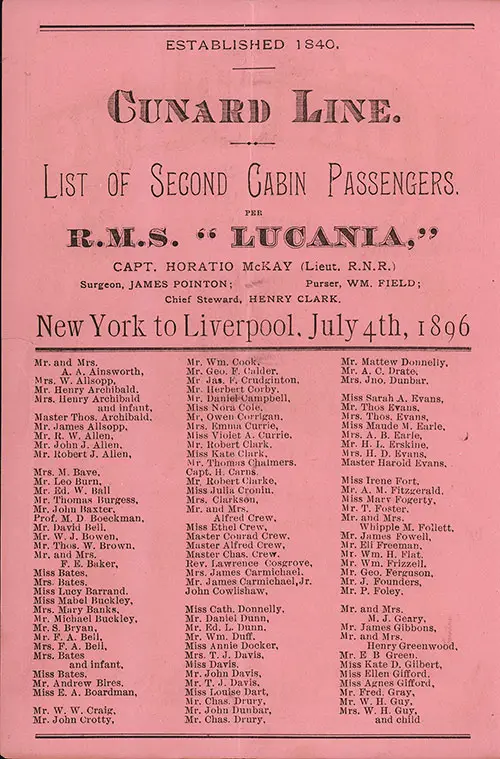
Title Page and List of Second Class Passengers, Part 1 of 2, RMS Lucania Second Class Passenger List, 4 July 1896. | GGA Image ID #
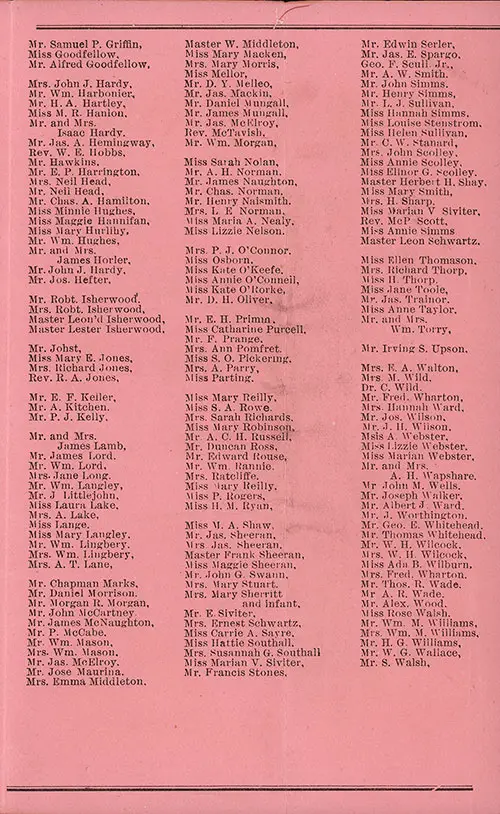
List of Second Class Passengers, Part 2 of 2, RMS Lucania Second Class Passenger List, 4 July 1896. | GGA Image ID # 238224b630
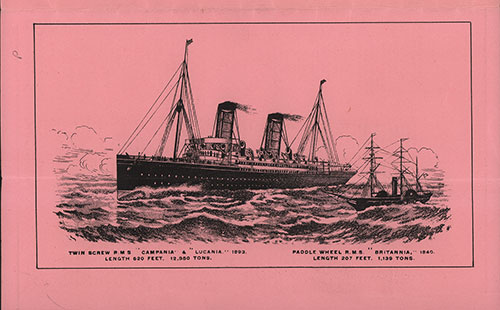
Back Cover Illustration: (l) Twin Screw RMS Campania & Lucania, 1893. Length 620 Feet, 12,950 Tons. (r) Paddle Wheel RMS Britannia, 1840, Length 207 Feet, 1,139 Tons. RMS Lucania Second Class Passenger List, 4 July 1896. | GGA Image ID # 238287e890
⚠️ "Probable Errors" Box – Duplicates & Spelling Oddities 📝
Because the list was typeset and possibly later transcribed, a few names and details likely contain typographical or duplication errors. These should be flagged rather than silently corrected, so researchers know to treat them cautiously:
Probable Duplicates / Repeats
- Mr. Chas. Drury – appears twice in close succession; likely one individual listed twice or two related travelers with identical name.
- Mr. Jas. McElroy – appears more than once; may indicate a duplication or father/son with same initials.
- Miss Marian V. Siviter – appears twice (once with Marian V. Siviter, another as Marian V Siviter), probably the same person.
Likely Typos / Mis-set Names
- "Mr, Owen Corrigan" – comma instead of period after "Mr" (Mr, → Mr.).
- "Mr. A. C. Drate" – possibly Drake; further corroboration needed from other sources.
- "Mr. D. Y. Melleo" – likely Mellor or Mello; name should be cross-checked against other records.
- "Miss Naggie Sheeran" – probably Maggie.
- "Msis A Webster" – likely Miss A. Webster.
- "L.izzie Webster" – should almost certainly be Lizzie Webster.
- "Mr. J. H. Wiison" – missing the "l" in Wilson.
- "Mr. Wm. M. Wiiliams" – probably Williams.
- "Mrs. Hlannah Ward" – likely Hannah Ward.
These notes are ideal for a small editorial sidebar on the page and make a great teaching example of why archivists and historians must preserve original spellings while noting probable issues.
🧩 Contextual Notes & Ship Features (Quick Reference)
- Ship: RMS Lucania (Cunard Line)
- Voyage Date: 4 July 1896
- Route: New York → Liverpool
- Class Covered: Second Class
- Commander: Captain Horatio McKay (Lt., R.N.R.)
- Typical Route: Liverpool–New York express mail and passenger service
Notable Features:
- Sister ship to RMS Campania
- Among the largest and fastest liners of her time
- Blue Riband holder for fastest Atlantic crossing (mid-1890s)
- Back cover illustration explicitly contrasts her with the much smaller 1840 RMS Britannia
🏁 Final Thoughts – Why This Passenger List Matters 💎
The RMS Lucania Second Class Passenger List – 4 July 1896 is far more than a simple roster of names:
- It captures middle-class transatlantic mobility at the height of the steamship age.
- It documents a holiday-weekend departure from New York aboard one of the world's fastest liners, connecting the U.S. and Britain in a single, elegant artifact.
- It preserves the names and family structures of hundreds of travelers—parents, children, clergy, a professor, an educator, and countless "ordinary" men and women whose lives intersected on this single crossing.
- Visually, the back-cover comparison of Britannia vs. Lucania/Campania makes the entire story of 19th-century maritime progress instantly graspable.
For teachers, it's a classroom-ready primary source.
For students, it's a window into real people behind big ships and big dates.
For historians and genealogists, it's a dense, name-rich document with excellent potential for follow-up research in newspapers, archives, and institutional records.
In short, this passenger list is a compact, human-scale snapshot of high-speed Victorian globalization, preserved in paper and ink—and now in digital form—for new generations to explore. 🌍�
📜 Research note: Some names and captions were typed from originals and may reflect period spellings or minor typographical variations. When searching, try alternate spellings and cross-check with related records. ⚓
Curator’s Note
For over 25 years, I've been dedicated to a unique mission: tracking down, curating, preserving, scanning, and transcribing historical materials. These materials, carefully researched, organized, and enriched with context, live on here at the GG Archives. Each passenger list isn't just posted — it's a testament to our commitment to helping you see the people and stories behind the names.
It hasn't always been easy. In the early years, I wasn't sure the site would survive, and I often paid the hosting bills out of my own pocket. But I never built this site for the money — I built it because I love history and believe it's worth preserving. It's a labor of love that I've dedicated myself to, and I'm committed to keeping it going.
If you've found something here that helped your research, sparked a family story, or just made you smile, I'd love to hear about it. Your experiences and stories are the real reward for me. And if you'd like to help keep this labor of love going, there's a "Contribute to the Website" link tucked away on our About page.
📜 History is worth keeping. Thanks for visiting and keeping it alive with me.

Cunard Line Passenger List Collection
GG Archives
Cunard Line Passenger Lists - 1881-1919
- 1881-07-16 Scythia
- 1882-07-08 Servia
- 1886-10-23 Etruria
- 1887-02-26 Aurania
- 1887-03-26 Aurania
- 1887-06-18 Servia
- 1887-08-23 Pavonia
- 1888-06-09 Umbria
- 1888-08-30 Scythia
- 1890-03-15 Etruria
- 1890-08-16 Umbria
- 1891-10-03 Umbria
- 1893-04-29 Umbria
- 1895-05-18 Campania
- 1895-06-29 Campania
- 1895-08-22 Cephalonia
- 1895-08-31 Campania
- 1895-10-12 Campania
- 1898-04-01 Etruria
- 1898-04-30 Etruria
- 1898-05-07 Campania
- 1898-08-27 Etruria
- 1898-09-03 Campania
- 1898-09-20 Scythia
- 1898-12-24 Lucania
- 1899-06-17 Lucania
- 1899-09-23 Campania
- 1900-09-08 Lucania
- 1900-09-22 Lucania
- 1901-04-20 Lucania
- 1901-10-19 Campania
- 1901-10-01 Ivernia
- 1902-08-16 Lucania
- 1902-09-16 Saxonia
- 1904-06-11 Etruria
- 📜 Voyage of the SS Carpathia: Prominent Passengers & Their Historic Legacies (1904)
- 1904-10-25 Saxonia
- 1905-05-23 Saxonia
- 1905-06-20 Ivernia
- 1905-07-22 Umbria
- 1905-08-19 Pannonia
- 1905-11-18 Lucania
- 1906-05-08 Caronia
- Voyage of Influence: Saloon Passenger List of the RMS Carmania, 5 June 1906
- 1906-08-21 Saxonia
- 1907-09-17 Saxonia
- 1908-01-19 Campania
- 1908-04-11 Mauretania
- 1908-06-06 Lusitania
- 1908-07-15 Ivernia
- 1908-09-10 Etruria
- 1909-03-20 Lusitania
- 1909-03-31 Lusitania
- 1909-05-18 Ivernia
- 1909-07-27 Saxonia
- 1909-10-06 Mauretania
- 1910-05-24 Ivernia
- 1910-07-16 Campania
- 1910-07-19 Saxonia
- 1910-09-24 Campania
- 1911-04-01 Caronia
- 1911-04-22 Carmania
- 1911-06-14 Mauretania
- 1911-07-29 Caronia
- 1911-08-08 Franconia
- 1911-08-29 Ascania
- 1912-03-30 Caronia
- 1912-05-28 Laconia
- 1912-06-11 Laconia
- 1912-08-06 Laconia
- 1912-08-17 Lusitania
- 1912-08-21 Saxonia
- 1912-09-03 Laconia
- 1912-10-01 Laconia
- 1912-11-02 Caronia
- 1912-11-23 Carmania
- 1913-06-10 Laconia
- 1913-07-03 Ausonia
- 1913-08-02 Carmania
- 1913-09-23 Carmania
- 📖 Voyage to the New World: The SS Carpathia's 1913 Passenger List & Legacy
- 1914-07-11 Aquitania
- 1914-07-29 Carmania
- 1914-08-22 Franconia
- 1914-09-01 Laconia
- 1917-03-17 Orduna
- 1919-01-14 Caronia
Cunard Line Ship Archival Collections
- Aquitania
- Ascania
- Aurania
- Campania
- Caronia
- Carpathia
- Cephalonia
- Etruria
- Franconia
- Ivernia
- Laconia
- Lucania
- Lusitania
- Mauretania
- Orduna
- Pannonia
- Pavonia
- Saxonia
- Scythia
- Servia
- Umbria
Other Related Sections
- Cunard Line History and Ephemera
- Description of Archival Records: Cunard Line Passenger Lists
- Inventory of Cunard Line Passenger Lists
- Postcards from the Cunard Line
- Passenger List Image Library
Passenger Lists
- Allan Line
- American Export Lines
- American Line
- American Merchant Lines
- Anchor Line
- Atlantic Transport Line
- Baltimore Mail Line
- Canadian Pacific (CPOS)
- Cunard-White Star Line
- Cunard Line
- Dominion Line
- Fabre Line
- French Line (CGT)
- Hamburg America Line
- Holland-America Line
- Italian Steamship Lines
- Leyland Line
- North German Lloyd
- Norwegian-America Line (NAL)
- Red Star Line
- Royal Mail Steam Packet Company
- Scandinavian American Line
- Swedish American Line
- Union-Castle Line
- United American Lines
- United States Lines
- White Star Line
- Miscellaneous
- Passenger Lists FAQs
Search Our Ship Passenger Lists
- Passenger Lists by Steamship Line
- Passenger Lists by Ship
- Passenger Lists by Port of Call
- Passenger Lists by Year
- Passenger Lists by Region
Ocean Travel Topics A-Z
- Boutique Shops & Ship's Stores
- Ocean Travel Books
- Brochures - Steamships & Ocean Liners
- Correspondence, Shipboard
- Fleet Lists of Passenger Ships
- Ships and Ocean Liners Archival Collections
- Interesting Fun Facts and Factoids
- Journeys in Steerage
- Ocean Journeys
- Other Ephemera
- Passage Contracts and Tickets
- Postcards of Steamships & Ocean Liners
- Programs and Concerts
- Provisioning Ocean Liners
- Sanitation at Sea
- Ship Passenger Lists
- Ship Publications
- Shipboard Affairs
- Steamship Captains
- Steamship Crew
- Steamship Lines
- Ship Tonnage and Measurements
- Steamship Port of Calls
- Stowaways Onboard
- RMS Titanic
- Transatlantic Voyages
- Travel Guide (1910)
- Vintage Advertisements
- Vintage Ocean Liner Menus